
Stop calling it a bulk if your plan is just “eat everything in sight.”
That is not a strategy. That is appetite with a gym membership.
Building muscle is not a food contest. It is an architectural project. You are not just trying to weigh more. You are trying to build lean tissue with precision. That means your calories matter, but your macros for muscle gain matter even more. Get them wrong, and you end up softer, slower, and wondering why your “bulk” looks like a parking lot meal deal. Get them right, and you create the internal environment for hypertrophy, recovery, strength, and consistent progress.
This guide breaks down the real muscle-building blueprint: how much protein you need, why carbs are your secret anabolic catalyst, why fats matter for hormones, which macro ratios actually make sense, and how to use a practical bulking macro calculator mindset without overcomplicating your life.
If your goal is explosive growth, this is where you stop guessing.
What Macronutrients Should I Eat to Build Muscle?
If you want the short answer first, your muscle-gain diet should prioritize:
- Protein to trigger muscle protein synthesis and support repair
- Carbohydrates to fuel hard training and spare protein
- Fats to support hormones, recovery, and calorie density
A strong starting point for many lifters is:
- 40–45% carbohydrates
- 25–30% protein
- 25–30% fat
That is not magic. It is simply a practical structure that supports training output, recovery, and a calorie surplus without letting one macro crowd out the others.
Why “Just Eat More” Fails Most Lifters
There is a reason sloppy bulks disappoint people.
More food does not automatically mean more muscle. A calorie surplus creates the opportunity to grow, but the quality and distribution of those calories determine what kind of weight you gain.
When people bulk badly, they usually do one or more of these:
- under-eat protein
- under-eat carbs around training
- keep fats too low
- rely on junk calories instead of performance food
- gain weight too fast
- confuse fullness with progress
Muscle is expensive tissue. Your body does not build it just because you crushed burgers after leg day. You need the right raw materials, the right training signal, and enough recovery for those materials to be used well.
That is why this is not about eating more. It is about eating optimized.
The Golden Ratio for Hypertrophy
There is no single perfect macro ratio for every athlete, but certain setups work extremely well for hypertrophy because they balance training fuel, recovery, and hormone support.
Two strong starting points
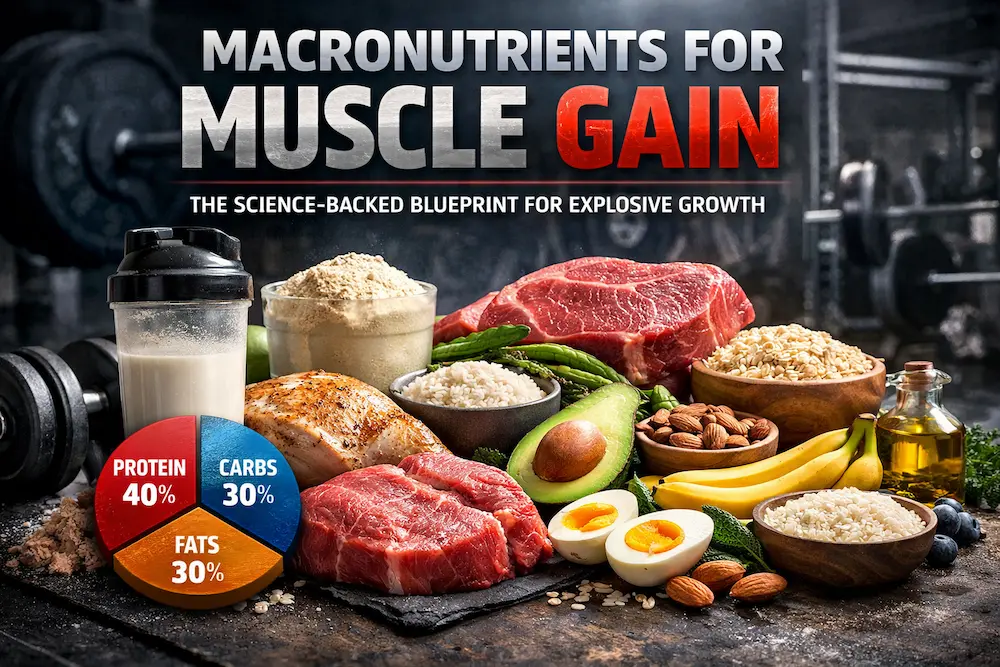
Option 1: 40/30/30
- 40% carbs
- 30% protein
- 30% fat
This works well for:
- moderate-volume lifters
- body recomposition phases
- bulks where appetite is strong but calories are controlled
Option 2: 45/25/30
- 45% carbs
- 25% protein
- 30% fat
This works well for:
- high-volume training
- bigger lifters
- people who perform better with more carbs
- lean bulking phases
Why these ratios work
They help create an environment that supports:
- better training performance
- improved glycogen availability
- strong nitrogen balance
- enough protein for repair
- enough fat for hormonal stability
Positive nitrogen balance is one of the core concepts in muscle gain. When protein intake and recovery are sufficient, the body is in a better position to build and retain lean mass.
Is 40/30/30 good for muscle gain?
Yes, 40/30/30 can be very good for muscle gain, especially for lifters who want a balanced, structured bulk. It provides enough protein for hypertrophy, enough carbs to train hard, and enough fat to support hormones and calorie intake.
Is 35-35-30 a good macro?
It can work, but it is usually more protein-heavy than necessary for many lifters. 35/35/30 may make sense in a lean gain phase or during a mild calorie surplus, but some people perform better with more carbohydrates and slightly less protein.
What is 40 40 20 macros for bulking?
A 40/40/20 split means:
- 40% carbs
- 40% protein
- 20% fat
It is usually more aggressive on protein than most bulking phases require, and sometimes too low in fat for optimal long-term hormonal support. It can work in certain body composition phases, but it is not usually the best default bulking ratio.
Protein: The Anabolic Trigger
Protein is not just “important.” It is the anabolic trigger that tells your body to repair and build.
But here is where most content gets lazy. It stops at “eat chicken.” That is beginner-level advice. If you want real growth, you need to understand Muscle Protein Synthesis (MPS) and leucine thresholds.
Muscle Protein Synthesis in simple English
MPS is the process by which your body builds new muscle proteins. Resistance training stimulates it. Protein intake supports it. The goal is to repeatedly create strong signals for muscle repair and growth across the day.
That means total daily protein matters. But meal quality matters too.
Why leucine matters
Leucine is one of the key amino acids involved in triggering MPS. Think of it as one of the main ignition keys for growth.
Higher-quality protein sources usually provide more leucine per serving, including:
- whey protein
- dairy
- eggs
- chicken
- beef
- fish
- soy
- blended plant proteins
A practical muscle-building meal should usually provide enough high-quality protein to cross a useful leucine threshold and stimulate growth effectively.
The 1.6g to 2.2g per kg Rule
This is the protein rule that matters most.
A strong evidence-based range for protein intake for hypertrophy is:
- 1.6 to 2.2 grams of protein per kilogram of body weight per day
That means:
- 70 kg lifter: 112–154g/day
- 80 kg lifter: 128–176g/day
- 90 kg lifter: 144–198g/day
For most people trying to build muscle, this range is more than enough when training is hard and calories are in a surplus.
When to push toward the higher end
Use the upper end when:
- you are lean and trying to stay lean while gaining
- appetite is inconsistent
- you are older
- you are in a very controlled surplus
- your training volume is high
Smart protein distribution
Do not dump all your protein into dinner.
A better approach:
- 4 to 5 feedings per day
- roughly 25–40g protein per meal
- one of those around training
That is how you create repeated anabolic opportunities.
Carbohydrates: Your Secret Anabolic Weapon
Carbs are wildly underestimated in muscle-gain nutrition.
Protein gets the attention. Carbs do the heavy lifting behind the scenes.
If protein is the building material, carbs are the construction crew’s energy source.
Why carbs matter for hypertrophy
Carbs help:
- fuel hard training
- replenish glycogen
- improve training volume
- support recovery
- spare protein from being used as energy
- help create a more anabolic environment through insulin response
About insulin
Yes, insulin is often called the body’s most anabolic hormone. That does not mean you need to chase sugar spikes like a maniac. It means carbohydrates help support a recovery environment where nutrients are better utilized.
This matters because intense training burns through glycogen. If you do not replace it well, performance suffers. And if performance suffers, muscle gain slows down.
Performance Carbs vs Recovery Carbs
Performance Carbs
These are easy-to-digest, gym-friendly carbs that support training output:
- white rice
- oats
- cream of rice
- potatoes
- sourdough bread
- bagels
- rice cakes
- bananas
Recovery Carbs
These help refill glycogen and pair well with protein after training:
- jasmine rice
- cereal
- fruit
- potatoes
- pasta
- oats
- low-fat granola
- sports drinks in some cases
Carb target for muscle gain
Many lifters do well with roughly:
- 3 to 6 g/kg/day, depending on size, volume, and training style
People doing very high-volume lifting, sports performance work, or hybrid training often need more.
Fats: The Testosterone Foundation
Low-fat diets are one of the most common silent muscle killers.
Why? Because fat is not just a calorie source. It supports:
- hormone production
- testosterone synthesis
- cell membrane health
- vitamin absorption
- long-term energy balance
If you slash fats too hard in a bulk, you may create a diet that looks “clean” on paper but performs terribly in reality.
Why fats matter for muscle gain
Appropriate dietary fat helps support:
- testosterone
- satiety
- calorie density
- recovery
- adherence
That does not mean you need to drown your meals in oil. It means fat needs to be present, not treated like a dietary enemy.
Best fat sources for a bulk
- whole eggs
- olive oil
- avocado
- nuts
- nut butter
- salmon
- dark chocolate in moderation
- seeds
Good fat target
A practical range for most bulking diets is:
- 20–30% of total calories
Below that, some lifters start to feel worse, recover worse, or struggle with food satisfaction.
The Bulking Hierarchy: Good, Better, Best
This is the shareable part. Save it. Screenshot it. Use it.
| Macro | Good | Better | Best |
|---|---|---|---|
| Protein | chicken breast, tuna, Greek yogurt | lean beef, eggs, cottage cheese, tofu | whey isolate, salmon, high-quality mixed whole-food protein meals |
| Carbs | bread, pasta, cereal | rice, oats, potatoes, fruit | cream of rice, jasmine rice, oats + fruit around training |
| Fats | cheese, dark chocolate, peanut butter | olive oil, avocado, nuts | extra virgin olive oil, salmon, mixed nuts, whole eggs |
| Post-Workout Combo | shake + banana | whey + rice cereal | whey + cream of rice + fruit |
| Convenience Foods | bars | ready rice + chicken packets | prepped meals with measured protein, carbs, and fats |
What this table really means
“Best” does not mean “perfect.” It means more optimized for training, digestion, and consistency.
Nutrient Timing: The Pre, Intra, and Post-Workout Strategy
You do not need to obsess over every minute of the clock. But nutrient timing does matter when muscle gain is the goal.
60 minutes before training
Eat:
- 25–35g protein
- 30–60g easy-to-digest carbs
- low to moderate fat
- low fiber if your stomach is sensitive
Examples:
- whey + oats + banana
- chicken and rice
- Greek yogurt + cereal
- cream of rice + protein powder
Intra-workout
This is usually optional unless:
- sessions are long
- training volume is high
- you are doing two sessions a day
- you struggle with energy during training
If needed:
- water + electrolytes
- sports drink
- essential amino acids only if overall protein is poor, which ideally it is not
30 minutes after training
Eat:
- 25–40g protein
- 40–80g carbs, depending on size and session intensity
Examples:
- whey shake + cereal
- chicken + rice
- lean beef + potatoes
- Greek yogurt + granola + fruit
Do not make this complicated. Just make it consistent.
Bulking Macro Calculator: A Practical Starting Formula
You do not need a fancy app to get started.
Here is a simple method:
Step 1: Set calories
Eat 250–500 calories above maintenance
Step 2: Set protein
Use 1.6–2.2 g/kg/day
Step 3: Set fat
Use 0.6–1.0 g/kg/day or around 20–30% of calories
Step 4: Fill the rest with carbs
Carbs take the remaining calories and become your training fuel
Example for an 80 kg lifter
- Calories: maintenance + 300
- Protein: 160g
- Fat: 70g
- Carbs: remainder of calories
That is your basic bulking macro calculator logic.
Common Dirty Bulking Mistakes: Why Pizza Bulks Fail
Let’s be honest.
A lot of “dirty bulking” is just undisciplined eating wearing a gym hoodie.
Here are 5 reasons pizza bulks fail:
1. You gain fat faster than you build muscle
Congrats. You discovered calorie surplus. That does not mean you built quality size.
2. Your training fuel is inconsistent
One day you eat 5,000 calories. The next day you eat nothing until 4 p.m. That is not a bulk. That is chaos.
3. Your digestion gets wrecked
Heavy junk-food bulks often lead to bloating, sluggish training, and bathroom regrets that do not exactly scream “optimized hypertrophy.”
4. Your food quality tanks
If your “bulk” is mostly takeout, you are probably getting more sodium, more junk fats, and less micronutrient support than you think.
5. You confuse scale weight with progress
Yes, you gained 15 pounds. No, that does not mean your physique improved. A fast bulk often just creates a future cutting problem with extra emotional damage.
Slightly aggressive truth: if your bulk looks like a teenage sleepover menu, do not act shocked when your abs disappear before your chest grows.
FAQ
How many calories over maintenance do I need?
A smart surplus is usually 250 to 500 calories over maintenance per day. Smaller surpluses often produce leaner gains. Bigger surpluses may speed up weight gain, but they usually bring more fat with them.
Can I gain muscle on a keto diet?
Yes, technically you can. But for most lifters, it is not the most efficient path. Carbs support training volume, glycogen, recovery, and performance. If maximal hypertrophy is the goal, moderate to higher carb intake usually works better.
Is a 40/40/20 split good for bulking?
It can work, but it is often too high in protein and too low in fat for many lifters. A more balanced split like 40/30/30 or 45/25/30 is usually more practical for long-term muscle gain.
What macronutrients should I eat to build muscle?
To build muscle, prioritize:
- enough protein for MPS and repair
- enough carbs for training and glycogen
- enough fat for hormones and calorie support
Is 40/30/30 good for muscle gain?
Yes. For many lifters, 40/30/30 is one of the best balanced starting points for hypertrophy.
Is 35-35-30 a good macro split?
It can work, especially if you like higher protein. But some lifters will train and recover better with slightly more carbs.
What is 40 40 20 macros for bulking?
It means 40% carbs, 40% protein, 20% fat. It is workable, but usually not the most optimized or sustainable muscle-gain setup.
Final Thoughts
Muscle gain is not random.
It is built on progressive training, a controlled surplus, and a macro setup that actually supports growth. That means enough protein to trigger hypertrophy. Enough carbs to train like a machine. Enough fats to keep hormones and recovery moving in the right direction.
That is the blueprint.
If you want explosive growth, stop treating your diet like an afterthought. Build it like the rest of your program: with intent, structure, and numbers that actually make sense.
Because the lifters who grow best are not the ones who eat the most.
They are the ones who eat smartest.