

Most people think they have an energy problem.
What they actually have is a fueling problem.
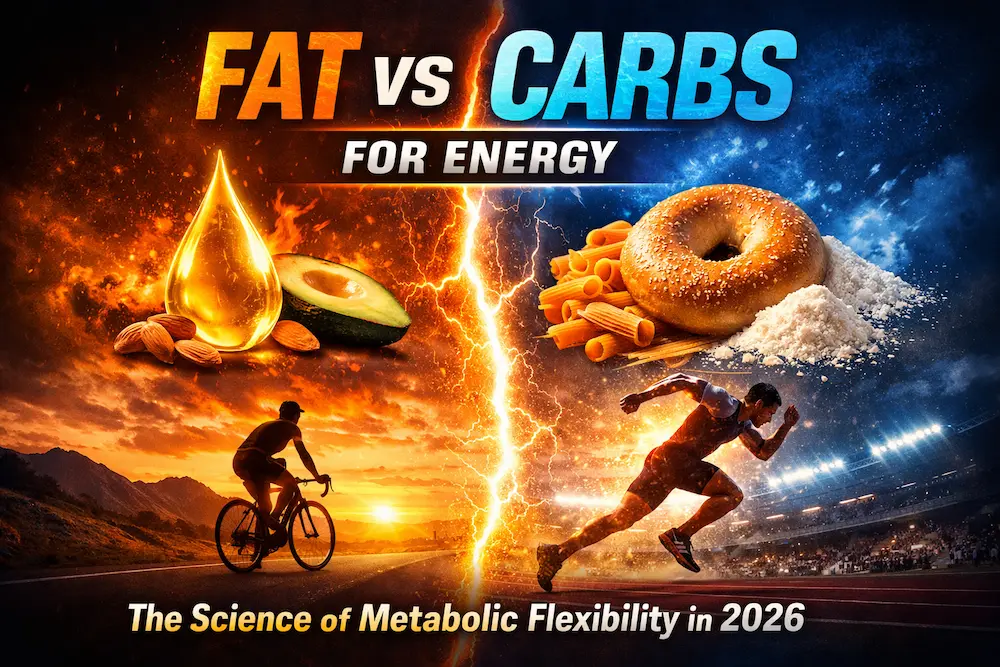
They wake up tired, lean on caffeine, crash at 3 PM, snack their way through the afternoon, and assume their metabolism is “slow.” In reality, many of them are trapped in a narrow fuel pattern: they are efficient at burning quick carbs, but poor at switching between carbohydrates and fat depending on demand. They are, in plain English, sugar burners.
That is where metabolic flexibility changes everything.
Metabolic flexibility is your body’s ability to switch between fuel sources efficiently. When intensity is high, you rely more on carbohydrates. When intensity is lower or duration gets longer, fat becomes a major fuel source. The healthiest, most resilient metabolism is not one that burns only fat or only carbs. It is one that can move between both with precision.
This is the real answer to the modern energy problem.
If you want better focus, fewer crashes, stronger endurance, smarter recovery, or a clearer answer to fat vs carbs for energy, this guide breaks down the physiology, performance tradeoffs, and practical strategy behind using both systems well.
Quick Answers First
Is it better to get energy from fat or carbs?
It depends on the situation. Carbs are better for high-intensity energy, while fat is better for lower-intensity, long-duration energy. The best system is metabolic flexibility, not choosing one fuel forever.
What makes up 90% of stored energy in your body?
For most people, around 90% or more of stored energy is body fat, kept in adipose tissue. Glycogen stores are much smaller by comparison.
Who gives more energy, carbohydrates or fats?
By weight, fat provides more calories: 9 calories per gram versus 4 calories per gram from carbohydrates. But carbohydrates can usually supply energy faster during intense exercise.
What is the 50 30 20 rule for carbs?
This usually refers to a general macro split such as 50% carbs, 30% protein, and 20% fat, often used in general wellness or performance nutrition contexts. It is not a universal rule, and it is not specifically a “carbs-only” rule.
Why Most People Crash at 3 PM
The afternoon crash is usually not random.
It often comes from some combination of:
- high-sugar, low-protein breakfasts
- low fiber intake
- poor sleep
- under-eating at lunch, then overeating later
- poor hydration
- weak metabolic flexibility
- constant reliance on fast glucose without stable meal structure
When the body is used to frequent spikes and dips in blood sugar, energy becomes reactive instead of stable. You feel great right after eating, then flat, then craving, then foggy.
That is not always a carb problem.
Often, it is a fuel management problem.
Section 1: The Physiology — How the Body Stores and Uses Energy
To understand fat vs carbs for energy, you need to understand what the body is actually storing.
Carbohydrates: Stored as Glycogen
When you eat carbohydrates, your body breaks them down into glucose. Some glucose is used immediately. Some is stored as glycogen, mainly in:
- muscles
- liver
These glycogen stores are limited.
That is the key point.
You can only store a relatively modest amount of glycogen compared with the enormous amount of energy the body can store as fat.
Why glycogen matters
Glycogen is valuable because it is:
- fast to access
- ideal for intense exercise
- important for repeated sprint efforts
- critical for hard training and brain-demanding performance in some settings
This is why glycogen depletion matters so much in endurance events, team sports, and hard training blocks.
Fat: Stored as Adipose Tissue
Fat is stored mainly in adipose tissue and, to a lesser extent, in smaller amounts inside muscle.
This is your long-term reserve tank.
Even lean people usually carry enough body fat to fuel a very large amount of low-intensity activity. That is why the answer to:
What makes up 90% of stored energy in your body?
is basically:
stored body fat in adipose tissue.
Compared to glycogen, fat stores are massive.
Why fat matters
Fat is:
- energy dense
- ideal for lower-intensity output
- useful during fasting or long-duration work
- important for hormone function and overall health
The problem is not that fat is weak. The problem is that it is slower to mobilize for very high-intensity demands.
ATP Yield: Why This Actually Matters
All usable energy in the body ends up in the form of ATP.
That is the energy currency your cells use.
Carbohydrates
Carbohydrates can produce ATP more quickly, especially when exercise intensity rises.
Fats
Fats can generate a very large total ATP yield, but the process is slower and more oxygen-dependent.
Practical takeaway
- Carbs win on speed
- Fat wins on capacity
That is the whole debate in one line.
Ketosis vs Glycolysis: Two Different Fuel Modes
This is one of the most important distinctions in modern fueling conversations.
Glycolysis
Glycolysis is the process of breaking down glucose for energy.
It dominates more during:
- hard lifting
- sprinting
- intervals
- high-intensity conditioning
- repeated explosive efforts
Ketosis
Ketosis happens when carbohydrate intake is low enough that the body increases ketone production, shifting more toward fat-derived fuel.
It can be useful in:
- low-carb dietary patterns
- fasting states
- certain therapeutic or medical nutrition contexts
- some endurance adaptation strategies
Important nuance
Ketosis is not automatically superior. Glycolysis is not automatically inferior.
They are different metabolic tools.
The most robust system is often not “always keto” or “always carb-loaded.” It is being able to access the right system at the right time.
That is metabolic flexibility.
Section 2: The Performance Matrix
This is where the theory becomes practical.
High-Intensity vs Low-Intensity Fuel Use
| Scenario | Primary Fuel Bias | Why It Happens | Best Nutritional Support |
|---|---|---|---|
| Sprint training | Carbs | Fast ATP demand, glycolytic output | Carbs before and after training |
| Heavy lifting | Carbs | High-force output needs fast available energy | Glycogen support and protein recovery |
| HIIT / intervals | Carbs | Rapid energy turnover | Moderate-to-high carb intake |
| Steady-state walking | Fat | Lower intensity allows more fat oxidation | Balanced meals, no need for huge carb loading |
| Zone 2 endurance work | Fat + carbs | Fat contributes more, carbs still matter as duration rises | Flexible fueling based on session length |
| Long endurance events | Mixed, then more carbs as needed | Glycogen preservation matters, but fat oxidation helps | Carb strategy plus aerobic efficiency |
| Fasted low-intensity work | Fat | Lower insulin, lower intensity | Often manageable if well-hydrated |
Expert interpretation
If you are training hard, avoiding carbs entirely may hurt output.
If you are sedentary, living on ultra-processed carbs may wreck energy stability.
Again, the answer is not extremism. It is match-the-fuel-to-the-demand.
Who Gives More Energy, Carbohydrates or Fats?
This question depends on what “more energy” means.
If you mean calories per gram:
- Fat = 9 calories per gram
- Carbohydrates = 4 calories per gram
So fat gives more energy by weight.
If you mean usable speed during hard performance:
Carbohydrates are usually better because they can be used more rapidly during high-intensity output.
Bottom line
- Fat = more dense
- Carbs = more explosive
Section 3: The 2026 Trend — Targeted Carbohydrate Cycles and Fat Adaptation
One of the most useful modern shifts in sports nutrition is moving away from rigid “team carb” versus “team keto” thinking.
Instead, smarter strategies are emerging around:
- Targeted carbohydrate cycles
- Fat adaptation
- Fueling matched to context
- Better support for endurance, brain performance, and recovery
What is fat adaptation?
Fat adaptation refers to training or eating in a way that improves the body’s ability to rely more heavily on fat as a fuel source at lower intensities.
This can be helpful for:
- long-duration endurance
- fasting tolerance
- steadier day-to-day energy
- reducing constant dependency on snacks
What fat adaptation is not
It is not a superpower that makes carbs unnecessary forever.
Athletes can become more fat-adapted and still benefit from strategic carbohydrate intake.
Targeted carbohydrate cycles
This means eating carbs more intentionally based on training demand.
Example:
- More carbs on hard training days
- Fewer carbs on rest or recovery days
- Carbs concentrated around key sessions
- More stable fat intake outside high-intensity windows
This can help with:
- glycogen support
- better insulin sensitivity
- lower mental food stress
- improved metabolic flexibility
Brain health and longevity angle
There is growing interest in how flexible fuel use may support:
- better insulin regulation
- more stable energy
- healthier aging
- improved mitochondrial efficiency
I want to be precise here: this does not mean everyone should go low-carb. It means learning to avoid metabolic rigidity may be beneficial.
Section 4: The Problem Areas — Keto Flu, Carb Bloat, and Hitting the Wall
This is where real people struggle.
The Keto Flu
The so-called keto flu is usually not true flu. It is often a combination of:
- low carbohydrate intake
- fluid shifts
- sodium loss
- poor electrolyte balance
- under-eating overall
- sudden diet transition
Common symptoms
- fatigue
- headache
- dizziness
- irritability
- poor exercise tolerance
- brain fog
How to reduce it
- increase sodium intentionally
- maintain potassium and magnesium intake
- hydrate consistently
- reduce carbs more gradually if needed
- do not simultaneously slash calories too hard
Fueling Checklist for Keto Flu Prevention
- Get enough sodium
- Do not ignore potassium
- Add magnesium-rich foods or appropriate support
- Drink enough fluids
- Keep protein adequate
- Do not panic if workouts feel off at first
Carb Bloat
On the other side, some people feel puffy, heavy, or bloated when they increase carbs.
This can happen because of:
- glycogen and water storage
- low fiber tolerance
- sudden carb increases
- poor-quality processed carbs
- digestive sensitivity
How to reduce carb bloat
- choose simpler carb sources first
- increase fiber gradually
- avoid giant cheat meals disguised as “refeeds”
- spread carb intake more evenly
- watch sodium-potassium balance
The problem is usually not carbs themselves.
It is often how they are added and what type they are.
Hitting the Wall: Why Athletes Crash Mid-Event
This is the performance version of the afternoon crash, and it is brutal.
“Hitting the wall” usually happens when:
- glycogen gets too low
- fueling is delayed
- hydration is poor
- pacing is too aggressive
- the athlete overestimates fat adaptation
Even a highly fat-adapted athlete can still hit a wall if the event intensity or duration exceeds what fat alone can support comfortably.
The solution
Athletes need to understand:
- when fat can carry more of the load
- when carbs need to be added strategically
- when electrolyte loss becomes the real limiter
What Is the 50 30 20 Rule for Carbs?
This phrase usually refers to a macro split:
- 50% carbs
- 30% protein
- 20% fat
It is often used in general fitness or structured meal planning, not as a fixed scientific law.
Is it good?
It can be useful for:
- active people
- performance-focused eaters
- moderate to high training volumes
But it is not ideal for everyone.
Someone sedentary, insulin resistant, or using a lower-carb approach may prefer a different distribution. The right split depends on the goal.
Fueling Checklist: How to Improve Metabolic Flexibility
Use this to improve both mental and physical energy.
Daily habits
- Eat enough protein at regular meals
- Pair carbs with fiber and protein when possible
- Include healthy fats for satiety
- Avoid living on sugar spikes and snack crashes
- Hydrate consistently
- Prioritize sleep
Training habits
- Include some lower-intensity aerobic work
- Support hard sessions with carbs
- Do not do every workout half-fueled and then wonder why performance drops
- Build endurance gradually
- Use rest days intelligently
Nutrition strategy
- Match carbs to demand
- Do not fear fat, but do not over-romanticize it either
- Avoid extreme all-or-nothing thinking
- Consider targeted carb timing around key sessions
- Keep electrolytes in mind when cutting carbs
Is It Better to Get Energy from Fat or Carbs?
Now that we have gone through the science, here is the real answer:
For high-intensity exercise, carbs are usually better.
They provide faster energy and support strong output.
For lower-intensity, longer-duration energy, fat is incredibly useful.
It is abundant, stable, and highly valuable.
For real-life health and performance, the goal is both.
You want a body that can:
- use fat well
- use carbs well
- switch between them without drama
That is metabolic flexibility.
And that is the answer most people actually need.
Expert Verdict
If you want peak mental and physical energy, stop asking whether fat or carbs is the “winner.”
That is the wrong question.
The winning system is a metabolism that can use carbs explosively when needed and fat efficiently when appropriate. Carbs are the premium fuel for intensity. Fat is the massive reserve tank for duration and stability. The healthiest, highest-performing body is the one that knows when to lean on each.
So here is the practical verdict:
- Use carbs strategically for training, performance, and intense output
- Build better fat oxidation capacity through aerobic fitness and better meal structure
- Support electrolyte balance if using lower-carb approaches
- Avoid both the all-carb crash cycle and the anti-carb fantasy
- Train your metabolism to be flexible, not ideological
That is how you stop living as a tired sugar burner and start fueling like someone who understands the system.