

Most people think weight gain is simple: eat more, move less.
That’s partially true — but here’s the part nobody explains properly:
Not all calories behave the same way in the body.
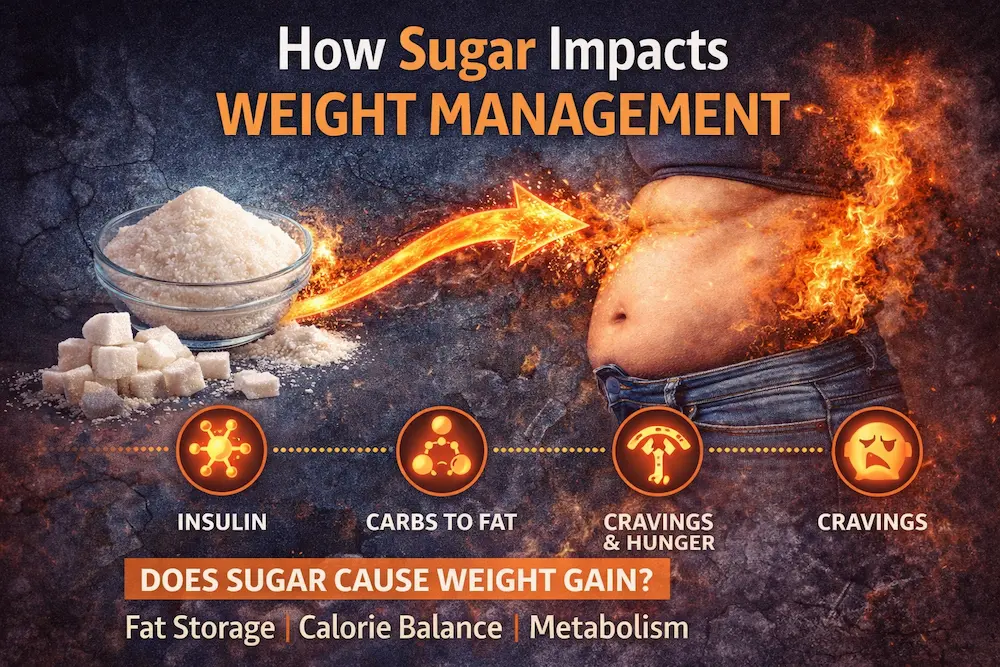
Sugar doesn’t just add calories. It affects hormones, hunger, fat storage, and even brain reward systems. That’s why two diets with the same calories can lead to very different results depending on sugar intake.
If you’ve ever felt like you’re “doing everything right” but still struggling with weight… sugar might be the hidden factor.
TL;DR (Quick Answers)
- Sugar can contribute to weight gain, but not overnight
- You can lose weight in a calorie deficit even with sugar, but it’s harder
- Sugary drinks are the biggest driver of weight gain
- High fructose intake is linked to visceral fat and metabolic issues
- Cutting sugar for 2 weeks can reduce cravings and improve control
What This Article Covers
- Can sugar make you gain weight overnight
- Sugar and weight loss
- Does sugar affect weight loss in a calorie deficit
- No sugar for 2 weeks effects
- Sugar and obesity
- Does white sugar increase weight
- Does sugar turn into fat
- How much sugar causes weight gain
The Biology: How Sugar Affects Fat Storage
Let’s start with what actually happens inside your body.
When you consume sugar, it breaks down into:
- Glucose → enters bloodstream → triggers insulin
- Fructose → processed mainly in the liver
Insulin & Fat Storage
Insulin is a storage hormone. Its job is to:
- move glucose into cells
- store excess energy
- reduce fat breakdown temporarily
According to Harvard Health Publishing, high intake of added sugars can contribute to metabolic dysfunction and weight gain over time.
When calories are high, insulin helps push excess energy into fat storage.
Fructose & Lipogenesis (Fat Creation)
Fructose behaves differently.
It is metabolized in the liver and can stimulate de novo lipogenesis — the process of turning carbs into fat.
A review indexed in PubMed (NIH) shows that high fructose intake is associated with:
- increased visceral fat
- insulin resistance
- higher triglycerides
👉 This is one of the strongest links between sugar and belly fat.
Can Sugar Make You Gain Weight Overnight?
Short answer: No.
You cannot gain meaningful body fat overnight.
But here’s why the scale goes up:
- glycogen storage (carbs stored with water)
- sodium retention
- food weight
According to the Mayo Clinic, fat gain requires a consistent calorie surplus over time.
👉 What you see the next day is mostly water — not fat.
Sugar and Weight Loss
Here’s the truth most people don’t want to hear:
👉 You can lose weight while eating sugar.
As long as you’re in a calorie deficit, weight loss happens.
BUT…
Sugar makes it harder because it:
- increases hunger
- spikes and crashes blood sugar
- reduces satiety
- triggers cravings
The Mayo Clinic confirms that added sugars increase calorie intake without providing fullness.
Does Sugar Affect Weight Loss in a Calorie Deficit?
Technically: No
Practically: Yes
This is where most people get confused.
A calorie deficit still works — but sugar can sabotage it by:
- making you hungrier
- increasing snacking
- reducing diet quality
A study on PubMed found that liquid sugar does not trigger satiety, meaning people don’t compensate by eating less later.
👉 This leads to higher total calorie intake — even unintentionally.
No Sugar for 2 Weeks: What Happens?
Cutting sugar for 14 days can lead to:
Week 1
- withdrawal-like cravings
- energy fluctuations
Week 2
- reduced cravings
- more stable energy
- easier appetite control
You may also lose weight — but part of it is:
- water loss
- reduced glycogen
According to Mayo Clinic Health System, early weight changes are often influenced by water balance.
👉 The real benefit is behavioral — not just fat loss.
Sugar and Obesity
This is where the science is very clear.
The World Health Organization (WHO) states:
- High sugar intake is linked to obesity
- Sugary drinks are a major risk factor
Harvard also confirms:
👉 Sugary drinks are strongly associated with weight gain
Why?
Because they:
- add calories quickly
- don’t fill you up
- are consumed frequently
Natural vs Added Sugar
This distinction is critical.
Natural sugars
- fruit
- milk
Added sugars
- soda
- sweets
- processed foods
According to Harvard Health:
👉 Added sugars are the main problem — not whole foods.
Fruit includes:
- fiber
- water
- nutrients
which slow digestion and improve satiety.
Why Sugary Drinks Are the Biggest Problem
This is the #1 driver of weight gain.
Research in PubMed shows:
- liquid calories bypass satiety
- people don’t eat less afterward
- total intake increases
This is why both:
- CDC
- Harvard
recommend reducing sugary drinks first.
Fructose, Visceral Fat & Leptin
Fructose doesn’t just affect fat — it affects hormones.
Studies on PubMed show links between fructose and:
- visceral fat accumulation
- leptin resistance
- insulin resistance
Leptin controls hunger.
When leptin signaling is disrupted:
👉 You feel hungrier even when you don’t need food.
Does White Sugar Increase Weight?
Yes — but indirectly.
White sugar is not “toxic,” but it:
- adds calories easily
- is highly palatable
- encourages overeating
The Mayo Clinic explains that excess added sugar contributes to weight gain mainly through increased calorie intake.
Does Sugar Turn Into Fat or Carbs?
Sugar is already a carbohydrate.
But when consumed in excess:
- Stored as glycogen
- Excess → converted to fat
This process (lipogenesis) is explained in NCBI.
👉 So yes — sugar can become fat, but only when intake exceeds needs.
How Much Sugar Causes Weight Gain?
There is no exact number.
But guidelines exist:
- WHO: <10% of calories (ideally <5%)
👉 https://www.who.int/tools/elena/interventions/free-sugars-adults-ncds - Harvard: similar recommendations
For a 2,000-calorie diet:
- ~25–50g added sugar per day
Consistently exceeding this increases risk of:
- weight gain
- obesity
- metabolic issues
What Most People Do vs What Works
| What people do | What actually works |
|---|---|
| Cut all sugar instantly | Reduce gradually |
| Focus only on calories | Improve food quality + satiety |
| Drink “healthy” juices | Replace with water or tea |
| Ignore liquid calories | Eliminate sugary drinks first |
| Chase perfection | Build consistency |
Practical Tips to Reduce Sugar
- Start with drinks (biggest impact)
- Choose whole foods over processed
- Add protein to reduce cravings
- Read labels (hidden sugars)
- Don’t aim for zero — aim for control
FAQ
Can I eat fruit while losing weight?
Yes. Fruit is generally weight-loss friendly due to fiber and low energy density.
(Source: Mayo Clinic)
How much added sugar is safe?
Less than 10% of daily calories, ideally under 5%.
(Source: WHO)
Does sugar stop fat loss?
No — but it can make it harder to maintain a calorie deficit.
Can sugar make you fat without overeating?
No. A calorie surplus is still required — but sugar makes it easier to reach that surplus.
Final Thoughts
Sugar is not the enemy.
But in modern diets, it is everywhere — and that’s the problem.
It affects:
- appetite
- hormones
- cravings
- calorie intake
And most importantly:
👉 It makes consistency harder.
If you want real results, focus on:
- reducing added sugars
- eliminating sugary drinks
- improving food quality
- staying consistent for 60–90 days
Because in the end, weight loss is not about perfection.
It’s about building a system your body can actually follow.
Disclaimer
This content is for informational purposes only. If you have pre-existing conditions such as diabetes or metabolic syndrome, consult your doctor before making changes to your diet.