
Healthy eating starts on the shelf, not in the kitchen.
If you cannot spot the tricks on a food label, it becomes much easier to buy products that look healthy but are actually loaded with sugar, salt, or low-quality ingredients. The good news is that you do not need to read labels like a dietitian. You just need a few fast rules that work every time.
Here are 7 smart nutrition label reading tips to help you choose healthier products in seconds.
1. Watch the serving size trap
This is one of the oldest tricks in packaged food.
A product may look low in calories, sugar, or sodium, but only because the company splits a small package into multiple servings. That means the numbers on the label may not reflect what you will actually eat.
Check this first:
- How many servings are in the package?
- Is that amount realistic for one sitting?
- Would you normally eat the whole pack?
If the package contains 2 or 3 servings and you eat all of it, you need to multiply everything:
- calories
- sugar
- fat
- sodium
Quick rule: Always check serving size before anything else.
2. Use the first 3 ingredients rule
If sugar or salt appears in the first three ingredients, take that as a warning sign.
Ingredients are listed in order from highest to lowest amount. So the first few ingredients tell you what the product is mostly made of.
Red flags in the top 3:
- sugar
- syrup
- salt
- refined flour
- glucose
- vegetable oil blends
Better top ingredients:
- oats
- nuts
- seeds
- beans
- whole grains
- yogurt
- fruit
Quick rule: If sugar or salt is in the top three, the product usually does not deserve a “healthy” reputation.
3. Look for hidden sugars
Sugar does not always show up as “sugar.”
That is why many people think they are buying healthy products when they are actually buying sweetened ones.
Common hidden sugar names:
- maltodextrin
- glucose syrup
- fructose
- sucrose
- dextrose
- corn syrup
- cane syrup
- brown rice syrup
- fruit juice concentrate
- honey
- agave syrup
This shows up a lot in:
- granola bars
- breakfast cereals
- flavored yogurts
- sauces
- plant-based milks
- protein snacks
Quick rule: If you see multiple sugar names in one product, it is probably sweeter than it looks.
4. Do not fear fat — check the type
Not all fats are the problem.
The real issue is the type of fat, especially when a product is high in trans fats or heavily processed fats.
Pay attention to:
- saturated fat
- trans fat
- hydrogenated oils
- partially hydrogenated oils
Many people still get distracted by “low fat” claims on the front of the package. But some low-fat products replace fat with more sugar or extra starch.
A smarter approach:
- do not judge food only by total fat
- look at saturated fat
- avoid trans fats as much as possible
- read the ingredient list for hydrogenated oils
Quick rule: Low fat does not always mean healthy.
5. Check the fiber content
Fiber is one of the easiest ways to tell whether a product is actually satisfying and useful nutritionally.
A product with more fiber usually helps more with fullness, digestion, and better food quality overall.
A simple fiber guide:
- 0–1g fiber per serving = very low
- 2–3g fiber per serving = moderate
- 4g or more per serving = a stronger choice
- 5g+ per serving = high fiber
This matters most for:
- bread
- cereals
- crackers
- snack bars
- wraps
Quick rule: For grain-based products, aim for at least 3–5 grams of fiber per serving when possible.
6. Watch the sodium
A product does not have to taste very salty to be high in sodium.
Sodium hides in many foods people assume are harmless.
Common high-sodium foods:
- bread
- soups
- frozen meals
- crackers
- sauces
- deli meats
- cheese snacks
Fast sodium tip:
A food starts looking “salty” when the sodium is high relative to the serving size, especially if it gives a high percentage of your daily intake in one serving.
A practical shortcut:
- 5% Daily Value or less = low
- 20% Daily Value or more = high
Quick rule: If sodium is 20% Daily Value or more, think twice before making it an everyday food.
7. Ignore the front-of-pack marketing claims
This may be the most important tip of all.
Words like:
- “low fat”
- “natural”
- “light”
- “multigrain”
- “high protein”
- “made with whole grains”
…can sound impressive, but they do not tell the full story.
The front of the package is marketing.
The back of the package is information.
A cereal can say “whole grain” and still be high in sugar.
A snack can say “natural” and still be ultra-processed.
A yogurt can say “low fat” and still be packed with sweeteners.
Quick rule: Never trust the front of the package without checking the label.
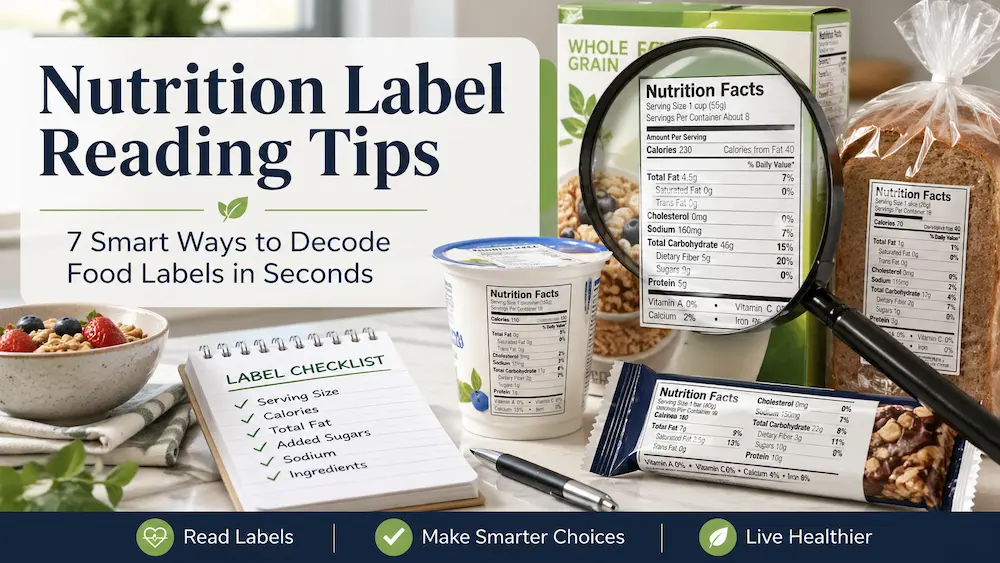
Your fast supermarket checklist
Next time you shop, use this quick system:
- Check the serving size
- Look at the first 3 ingredients
- Scan for hidden sugars
- Check the type of fat
- Look for fiber
- Review the sodium
- Ignore the front and trust the back
That is how you make smarter choices without spending 10 minutes on every product.
Final takeaway
You do not need a perfect diet.
You need a smarter filter.
The more quickly you learn to spot serving-size tricks, hidden sugars, low-fiber products, and misleading claims, the easier it becomes to choose healthier food with confidence.
Share this article with someone who always gets fooled by supermarket packaging, or sign up for the newsletter for more simple nutrition hacks that make healthy shopping easier.