
Walking through a supermarket should be simple.
But for most people, it feels like a maze.
One cereal says “high in fiber.” Another says “low fat.” A snack bar promises “natural energy,” while a yogurt claims it is “protein-packed.” Every package seems healthy—until you turn it around and see the label.
That is where the confusion starts.
Calories, serving sizes, percentages, ingredients, sugars with strange names, sodium levels, daily values—it can all feel overwhelming in seconds. The good news? It does not have to stay that way.
This article is your easy, practical nutrition facts guide. By the end, you will know how to read food labels like a pro, avoid common mistakes, and make smarter choices every time you shop.
Why Food Labels Matter
Food labels are not just tiny numbers on the back of a package.
They are one of the fastest tools you have to understand what you are really putting into your body.
A good label check can help you:
- compare products quickly
- avoid hidden sugars
- limit excess sodium
- spot empty calories
- choose foods with more nutrients
- make healthier decisions without guessing
If you have ever wondered how to read food labels, the answer is simple: start with the parts that matter most, not every tiny detail.
The Importance of Serving Size
If there is one thing most people get wrong, it is serving size.
The label may look healthy at first glance, but all the numbers you see—calories, sugar, fat, sodium—are based on the serving size listed at the top.
That means if the package says:
- Serving size: 1/2 cup
- Calories: 120
…and you eat 1 full cup, you are not eating 120 calories. You are eating 240 calories.
The same applies to:
- sugar
- sodium
- fat
- carbohydrates
- protein
Why serving size matters so much
Many packaged foods look healthier simply because the serving size is unrealistically small.
This happens a lot with:
- breakfast cereals
- chips
- cookies
- ice cream
- granola
- trail mix
- sugary drinks
So before you check anything else, always ask:
- How many servings are in this package?
- Is this a realistic amount for me?
- Am I likely to eat more than one serving?
Quick answer for featured snippet
What is the first thing to check on a food label?
The first thing to check is the serving size, because all the nutrition information is based on that amount.
Pro Tip: If you usually eat the whole package, multiply everything on the label by the number of servings inside it.
Calories vs Quality: Not All Calories Are Equal
Calories matter, but they are not the whole story.
Two foods can have the same number of calories and still affect your body very differently.
For example:
- A 200-calorie snack with fiber, protein, and healthy fats can keep you full.
- A 200-calorie snack full of refined starch and added sugar may leave you hungry again very quickly.
That is why smart shoppers do not only ask, “How many calories does this have?”
They also ask, “What kind of calories are these?”
How to spot “empty” calories
Empty calories usually come from foods that are high in:
- added sugars
- refined grains
- unhealthy fats
- low nutritional value
Examples include:
- sugary cereals
- pastries
- candy bars
- sweetened drinks
- many ultra-processed snacks
These foods may fit your calorie target, but they often do little for fullness, energy, or nutrition.
What to look for instead
A better food choice usually has:
- some protein
- some fiber
- moderate calories
- less added sugar
- a simpler ingredient list
Quick answer for featured snippet
How do you tell if calories are “empty”?
Empty calories usually come from foods that are high in sugar or unhealthy fats but low in nutrients like fiber, vitamins, and protein.
Pro Tip: Do not judge a food by calories alone. A higher-calorie food with better nutrients can be a smarter choice than a lower-calorie processed snack.
The “Hidden” Ingredients: Sugar, Saturated Fat, and Sodium
This is the section that can completely change the way you shop.
A product may look healthy from the front, but the back label often tells a different story.
The biggest hidden troublemakers are usually:
- added sugar
- saturated fat
- sodium
1. Hidden sugar and all its names
Sugar is not always listed as “sugar.”
It may appear as:
- cane sugar
- corn syrup
- glucose
- fructose
- maltose
- dextrose
- sucrose
- honey
- agave syrup
- fruit juice concentrate
- brown rice syrup
If several of these appear in one product, that is a warning sign.
This happens often in:
- flavored yogurts
- cereal bars
- breakfast cereals
- sauces
- “healthy” smoothies
- protein snacks
2. Saturated fat
Saturated fat is not automatically evil, but too much of it in packaged foods can be a problem—especially when it comes from processed products.
Watch out for foods that are high in:
- palm oil
- hydrogenated oils
- processed baked goods
- fried snacks
3. Sodium
Sodium is one of the most overlooked things on food labels.
People think only chips are salty, but sodium can be high in:
- soups
- breads
- sauces
- frozen meals
- deli meats
- crackers
Quick answer for featured snippet
What hidden ingredients should you watch for on food labels?
The main hidden ingredients to watch are added sugar, saturated fat, and sodium, especially in processed foods marketed as healthy.
Pro Tip: If sugar appears more than once in different forms on the ingredient list, the product is usually sweeter than it first looks.
The “Secret” of % Daily Value (%DV)
The % Daily Value section is one of the most useful parts of the label—and one of the most misunderstood.
It tells you whether a nutrient is low or high in one serving of the food.
The easiest way to remember it is the 5/20 rule:
- 5% DV or less = low
- 20% DV or more = high
How to use the 5/20 rule
Use this rule to decide quickly whether a food is low or high in nutrients you want to limit or get more of.
Nutrients you usually want less of:
- added sugars
- saturated fat
- sodium
Nutrients you often want more of:
- fiber
- calcium
- iron
- potassium
Example
If a food has:
- 4% DV of fiber → low fiber
- 22% DV of sodium → high sodium
- 18% DV of calcium → a decent source of calcium
This makes label reading much faster and easier.
Quick answer for featured snippet
What does 5% and 20% Daily Value mean?
A 5% Daily Value means the food is low in that nutrient. A 20% Daily Value means it is high.
Pro Tip: Use %DV to compare two similar products quickly. It is one of the best shortcuts in any nutrition facts guide.
Ingredient List: Why the Order Matters
The ingredient list is where smart shoppers gain a huge advantage.
Ingredients are listed in descending order by weight, which means the first ingredients make up the biggest portion of the product.
So if the first few ingredients are:
- sugar
- refined flour
- syrup
- oil
…then that tells you a lot, even before you look deeper.
What the ingredient order reveals
A better product often has first ingredients like:
- oats
- whole grain flour
- nuts
- seeds
- beans
- fruit
- milk
- yogurt
A more processed product may start with:
- enriched wheat flour
- sugar
- corn syrup
- vegetable oil
That does not mean every processed food is bad. It just means the order gives you useful clues about food quality.
Simple ingredient list rule
In general, the shorter and more recognizable the ingredient list, the better.
Not always. But often.
Quick answer for featured snippet
Why does the order of ingredients matter on food labels?
The order matters because ingredients are listed from highest to lowest amount, so the first few ingredients make up most of the product.
Pro Tip: If sugar is in the top three ingredients, think twice before buying it as a “healthy” everyday food.
A Simple Checklist for Your Next Grocery Trip
The next time you shop, you do not need to overanalyze every package.
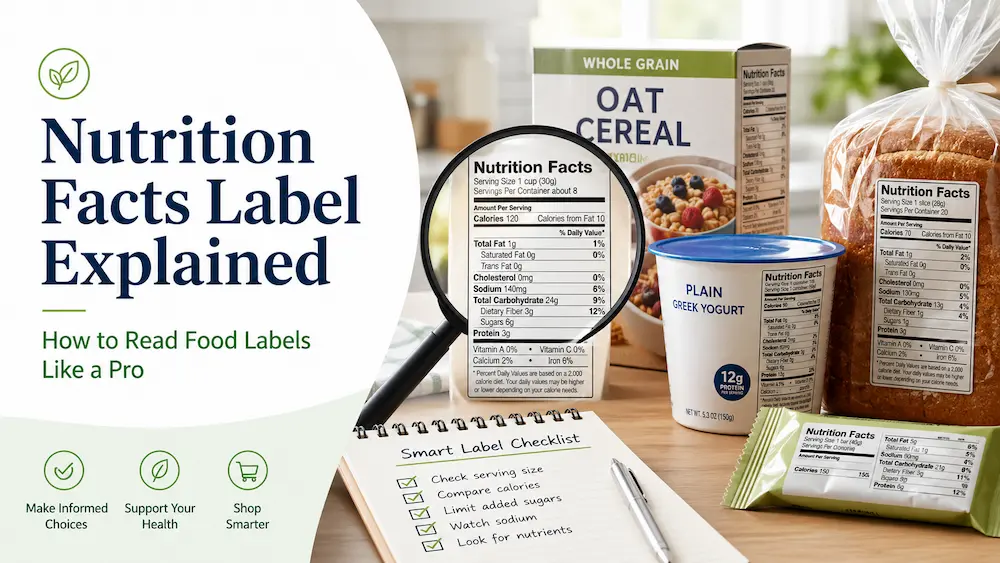
Just follow this quick checklist:
Smart label-reading checklist
- Check the serving size first
- Look at calories in context
- Scan sugar, saturated fat, and sodium
- Use the 5/20 rule for % Daily Value
- Look for fiber and protein
- Read the first 3–5 ingredients
- Watch for hidden sugar names
- Do not trust the front of the package blindly
This is the easiest way to understand the interpretation of a nutrition label without feeling overwhelmed.
FAQ
How do you read food labels correctly?
Start with the serving size, then check calories, sugar, sodium, saturated fat, % Daily Value, and the ingredient list.
What is the most important part of the Nutrition Facts label?
The most important part is usually the serving size, because all the other numbers are based on it.
What does % Daily Value mean?
It shows whether a food is low or high in a nutrient. 5% or less is low, 20% or more is high.
Why is the ingredient list important?
The ingredient list shows what the product is mostly made of. Ingredients are listed from highest to lowest quantity.
How can I identify hidden sugar?
Look for words like corn syrup, dextrose, fructose, sucrose, honey, agave, and fruit juice concentrate in the ingredient list.
How do I avoid empty calories?
Choose foods with fiber, protein, and simpler ingredients, instead of foods high in added sugar and low in nutrients.
Final Thoughts
Reading food labels does not have to feel complicated.
Once you understand a few basics—serving size, calories vs quality, hidden ingredients, % Daily Value, and ingredient order—you can shop with much more confidence.
You do not need to be a nutritionist.
You just need a simple system.
And now you have one.
So the next time you stand in the supermarket aisle wondering which product is actually better, flip the package over and let the label tell the real story.