

Sugar advice can feel confusing because people hear two different messages at once.
One says sugar is the enemy.
The other says “everything is fine in moderation.”
The truth sits in the middle.
For 2026, the most useful approach is not panic and not denial. It is clarity: how much added sugar is too much, how WHO sugar limits compare with broader public-health advice, what added sugar vs natural sugar really means, and how sugar habits affect long-term health and daily glucose management.
This guide explains the current practical standard, how to spot hidden sugars in modern foods, and what readers should understand before making major diet changes.
According to the World Health Organization, limiting free sugars remains a core public-health recommendation. Trusted clinical sources such as Mayo Clinic and WebMD also emphasize reducing added sugar as part of a healthier eating pattern.
A note on the 2025 DGA question
Because I do not have live web access in this chat, I cannot verify whether there were any newly published, official key changes in DGA 2025 beyond the broader guidance that has remained consistent in recent years.
So I will not invent updates.
What I can say, based on established nutrition guidance, is that U.S. dietary advice has consistently emphasized limiting added sugars, improving diet quality, and reducing reliance on ultra-processed foods. If you want this article later turned into a version tied to a specific government publication, it should be checked against the newest official Dietary Guidelines text before publishing.
The 2026 Standard
The practical standard for Sugar consumption guidelines for 2026 still centers on one key principle:
Limit added sugar, especially from drinks, desserts, and processed foods.
General adult guidance
The broad public-health consensus still supports keeping added sugars relatively low within total calorie intake.
- The WHO recommends reducing free sugars, with a strong recommendation to keep them below 10% of total energy intake.
- WHO also notes that reducing free sugars to below 5% of total energy intake may provide additional health benefits.
- In U.S. guidance over recent years, added sugars have generally been limited to less than 10% of daily calories.
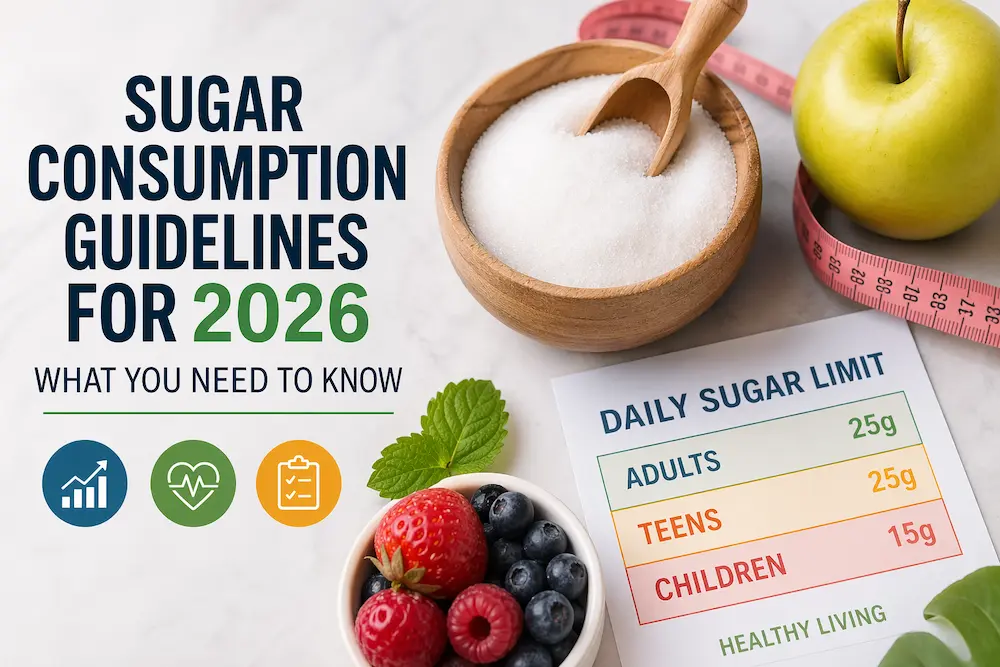
For a person eating around 2,000 calories per day, 10% equals about 50 grams of added sugar, while 5% equals about 25 grams.
That means many adults do best when they think in this range:
- Up to 50 grams per day as an upper public-health limit
- Closer to 25 grams per day as a more protective target
Guidance for children
Children should generally consume even less added sugar.
This matters because sugar can displace nutrient-dense foods and shape taste preferences early in life. Public-health recommendations have increasingly supported minimizing added sugar in young children and keeping intake low throughout childhood.
A clinically useful summary is:
- Infants and toddlers: as close to zero added sugar as possible
- Older children and teens: keep added sugar clearly below adult-style intake levels and avoid sugary drinks as a routine habit
Zero Added Sugar Recommendations
The phrase “zero added sugar recommendations” should be understood carefully.
For most adults, “zero added sugar” is not a formal universal requirement. It is better viewed as a strategic goal used in certain settings:
- for infants and very young children
- for people with very high sugar intake who need a reset
- for short-term elimination plans aimed at reducing cravings
- for individuals under medical nutrition guidance
In other words, zero added sugar can be a useful behavioral target, but the broader medical and public-health standard is usually low added sugar, not necessarily absolute zero for every adult.
Added sugar limits in DGAs
Even without claiming any unverified 2025 change, the long-standing direction of the Dietary Guidelines has been clear:
- added sugars should remain a limited part of the diet
- nutrient-dense foods should make up the majority of intake
- sugary beverages are one of the most important targets for reduction
- total eating pattern matters more than any one food in isolation
Added Sugar vs Natural Sugar
This is where many readers get confused.
Not all sugar appears in the same nutritional context.
Added sugar
Added sugar is sugar put into foods during processing, preparation, or packaging.
Common examples include:
- soft drinks
- sweetened yogurt
- flavored coffee drinks
- pastries
- candy
- sauces
- breakfast cereals
- protein bars
Natural sugar
Natural sugar occurs naturally in foods such as:
- fruit
- plain milk
- unsweetened yogurt
These foods usually come with a more complete nutritional package, including fiber, protein, vitamins, minerals, or water.
That is why added sugar vs natural sugar is not just a chemistry question. It is a whole-foods question.
An apple and a soda may both contain sugar, but they do not behave the same way in real life.
Hidden Sugars in Modern Foods
One of the biggest problems in 2026 is not obvious sugar.
It is hidden sugar in foods marketed as healthy.
Many people think they are eating well, but they are still consuming large amounts of sugar through products with “fitness,” “wellness,” or “natural” branding.
Common hidden sugar sources
- flavored yogurt
- granola
- oat bars
- bottled smoothies
- protein bars
- breakfast cereals
- plant-based milks
- salad dressings
- ketchup and sauces
- low-fat products
- instant oatmeal packets
Names sugar may hide under
- cane sugar
- brown rice syrup
- agave
- honey
- dextrose
- maltose
- fructose
- sucrose
- fruit juice concentrate
- corn syrup
A simple rule for label reading
If a product sounds healthy but tastes like dessert, check the label.
This is especially important for people working on daily glucose management, appetite control, or long-term metabolic health.
The Impact of Sugar on Long-term Health
Excess sugar does not only affect body weight.
It can also shape hunger patterns, energy stability, and long-term disease risk.
Metabolic health
High added sugar intake, especially from sweetened drinks and ultra-processed foods, can contribute to:
- higher calorie intake
- insulin resistance
- weight gain
- poorer metabolic health
- greater risk of type 2 diabetes
Clinical sources like Mayo Clinic consistently link excess added sugar with poorer overall health outcomes when it is part of an unhealthy dietary pattern.
Brain function and daily wellbeing
Sugar can also influence how people feel from day to day.
Common real-world effects include:
- energy crashes
- irritability
- cravings
- brain fog
- poor concentration
- unstable hunger
This does not mean sugar directly causes every mental or neurological issue. It means that frequent spikes and crashes can work against focus, appetite regulation, and overall wellbeing.
That is one reason daily glucose management has become such a major topic even outside diabetes care.
Simple Table: Recommended Sugar Intake by Activity Level
A basic way to explain intake is to separate total energy needs from the fact that sugar still should remain limited even when someone is more active.
| Activity Level | Example Daily Calories | Practical Added Sugar Upper Limit | More Conservative Target |
|---|---|---|---|
| Lower activity | 1,600 | 40 g | 20 g |
| Moderate activity | 2,000 | 50 g | 25 g |
| Higher activity | 2,400 | 60 g | 30 g |
How to read this table
- The “upper limit” reflects the common 10% of calories framework.
- The conservative target reflects the stricter 5% style approach often associated with added protection.
- Higher activity does not mean unlimited sugar intake.
- Even active people benefit from prioritizing whole foods over sugary processed products.
What matters most in real life
Most people do not need to count every gram forever.
They usually get the biggest benefit from doing three things well:
- cutting sugary drinks
- reducing hidden sugars in processed “health” foods
- building meals around protein, fiber, and minimally processed foods
That is the simplest way to make Sugar consumption guidelines for 2026 practical instead of theoretical.
Health Safety
Dietary needs vary significantly per individual. You should consult your doctor or a certified nutritionist before making specific changes to your sugar intake, especially if managing conditions like diabetes or insulin resistance.
For patient-friendly medical guidance, see the Mayo Clinic nutrition section and the American Diabetes Association.
FAQ
What are the WHO sugar limits?
The WHO recommends keeping free sugars below 10% of total daily energy intake, with a further reduction to below 5% offering additional potential benefits.
What is the difference between added sugar and natural sugar?
Added sugar is put into foods during processing or preparation. Natural sugar occurs naturally in foods like fruit and milk, which often contain fiber or other nutrients.
Are there zero added sugar recommendations?
Yes, especially for infants and very young children, where avoiding added sugar is widely encouraged. For adults, the broader standard is usually to keep added sugar low rather than assume absolute zero is required for everyone.
What are the added sugar limits in DGAs?
Recent Dietary Guidelines have generally limited added sugar to less than 10% of daily calories, although exact wording in the newest official publication should be checked before citing it in a live article.
Why does sugar matter for daily glucose management?
Frequent high-sugar intake can contribute to blood sugar swings, cravings, and unstable energy, which is especially relevant for people with insulin resistance, prediabetes, or diabetes.
Final takeaway
The biggest lesson for 2026 is simple:
Sugar guidance is less about fear and more about limits, context, and food quality.
If you understand the difference between added sugar vs natural sugar, keep an eye on hidden sugars, and stay within practical public-health limits, you do not need to be extreme to make meaningful progress.
A better sugar pattern usually starts with one decision:
drink less sugar, buy fewer sweetened processed foods, and let the rest improve from there.


