
“Healthy.” “Organic.” “Natural.” “No added sugar.” “Zero grams trans fat.”
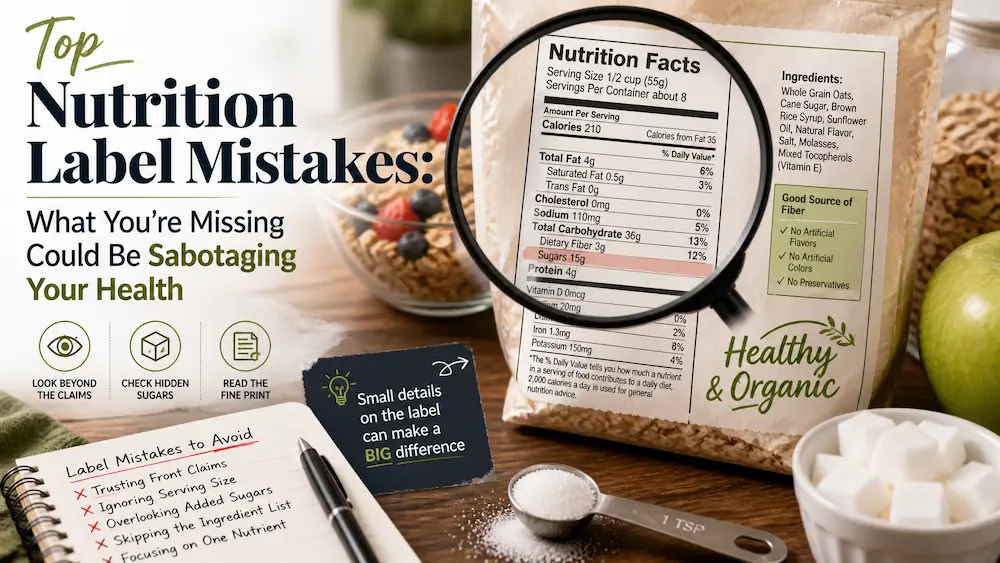
These labels sound like shortcuts to better choices. But here’s the uncomfortable truth: some of the most misleading foods in your cart are the ones wearing the healthiest-looking packaging.
A granola bar can look like a weight-loss snack while packing the sugar load of a dessert. A “zero trans fat” creamer can still contain small amounts per serving. A “low-calorie” meal may be low only because the serving size is unrealistically tiny.
Most people don’t fail at healthy eating because they lack discipline. They fail because food labels are easy to misunderstand.
This guide breaks down the most common nutrition label mistakes, why accurate food labeling matters, and how to read food labels in a way that actually supports weight loss, better energy, and healthier eating habits.
Medical note: This article is for general nutrition education only. For personalized dietary advice, especially if you have diabetes, heart disease, kidney disease, food allergies, or another medical condition, speak with a qualified healthcare professional.
TL;DR Summary: Nutrition Label Mistakes to Avoid
The biggest food label mistakes include ignoring serving size, trusting front-of-package claims, missing hidden sugars, misunderstanding “0g” claims, skipping ingredient order, and misreading % Daily Value. For healthier eating, always check the serving size first, scan the first three ingredients, compare added sugar and dietary fiber, look at caloric density, and avoid assuming that “organic,” “natural,” or “low-fat” automatically means healthy.
Competition Overview: What Most Food Label Guides Miss
Many articles about how to read food labels explain calories, fat, sugar, and serving size. That is useful, but incomplete.
The strongest ranking pages usually cover:
- Calories and serving sizes
- Saturated fat and sodium
- Added sugar
- % Daily Value
- Ingredient lists
Where many guides fall short is in the real-life traps: tiny serving sizes, sugar aliases, “zero” rounding rules, health-washing terms, and how processed foods use label design to look better than they are.
This article goes deeper by focusing on the mistakes people actually make in grocery stores, especially when trying to lose weight, reduce sugar, improve macronutrient balance, or build healthier eating habits.
What Are the Most Common Food Labelling Mistakes?
The most common food labelling mistakes happen when shoppers focus on the marketing and ignore the math.
A nutrition label is not just a calorie box. It tells you portion size, macronutrients, dietary fiber, added sugars, sodium, ingredient quality, and sometimes hidden additives. But if you read it in the wrong order, you can easily misjudge how healthy a food really is.
The biggest mistakes include:
- Reading calories before serving size
- Trusting “healthy,” “organic,” or “natural” claims
- Ignoring added sugar
- Missing sugar’s many aliases
- Believing “0g” always means none
- Misunderstanding % Daily Value
- Not checking the first three ingredients
- Confusing low-fat with healthy
- Ignoring dietary fiber
- Forgetting that processed foods can be engineered to look better on paper
Let’s break these down.
The Serving Size Scam: Why Doesn’t the Math Match Your Plate?
Serving size is the first thing you should check on any nutrition label.
Why? Because every number underneath it depends on that serving size.
A cereal box may list:
| Label Says | Reality |
|---|---|
| 150 calories per serving | You pour 2 servings |
| 8g sugar | You eat 16g sugar |
| 180mg sodium | You consume 360mg sodium |
| 2g fiber | You only get 4g even after doubling |
This is where many weight-loss plans quietly fall apart.
You may think you ate a 150-calorie snack, but if the package contains three servings and you ate the whole thing, you consumed 450 calories. That matters because calories, macronutrients, and caloric density all add up over the day.
What should you check first on a nutrition label?
Always check these in order:
- Serving size
- Servings per container
- Calories per serving
- Added sugar
- Dietary fiber
- Protein
- Sodium
- Ingredient list
This order prevents the most common mistake: judging a food before knowing how much the label is actually measuring.
Is 0g Sugar Actually Zero?
Not always.
This is one of the most misunderstood parts of food labeling.
In many labeling systems, very small amounts can be rounded down to “0g” if they fall below a certain threshold per serving. In the United States, for example, nutrition labeling rules have historically allowed certain nutrients, including trans fat, to be listed as 0g when the amount is less than 0.5g per serving.
That may sound harmless until you remember the serving size trick.
If one serving contains 0.4g trans fat and you eat four servings, that “0g” can become 1.6g in real life.
The “Zero” Myth: What 0g Can Hide
| Claim on Label | What People Think | What It May Mean |
|---|---|---|
| 0g trans fat | Absolutely no trans fat | May contain a small amount per serving |
| 0g sugar | No sugar at all | May contain trace amounts or sugar substitutes |
| Zero calories | No energy impact | May contain very small calories per serving |
| Sugar-free | Healthy | Could still contain sugar alcohols, additives, or high-calorie ingredients |
Here’s the part nobody tells you: “zero” claims often rely on serving size. A tiny serving makes a product look cleaner than it may be when eaten normally.
For trans fats, also scan the ingredient list for terms like “partially hydrogenated oil.” If you see that, be cautious, even if the label says 0g trans fat.
Sugar’s 50+ Aliases: What Names Hide Sugar on Food Labels?
Sugar is not always listed as “sugar.”
Food manufacturers may use different sweeteners that sound more technical, natural, or harmless. But your body still has to process them as part of your overall sugar and carbohydrate intake.
Common Sugar Aliases to Watch For
Here are names that may indicate added sugars or sweeteners:
| Sugar Alias | Commonly Found In |
|---|---|
| Maltodextrin | Protein bars, sauces, processed snacks |
| Barley malt | Cereals, granola, malt drinks |
| Brown rice syrup | “Natural” snack bars |
| Cane juice | Drinks, yogurts, cereals |
| Evaporated cane juice | Granola, “natural” sweets |
| Corn syrup | Sauces, desserts, packaged foods |
| High-fructose corn syrup | Soft drinks, sweets, condiments |
| Dextrose | Baked goods, processed foods |
| Fructose | Sweetened drinks, packaged snacks |
| Glucose | Sports products, sweets |
| Sucrose | Desserts, cereals |
| Lactose | Dairy-based foods |
| Maltose | Malted foods, cereals |
| Molasses | Baked goods, sauces |
| Agave nectar | “Natural” sweetened foods |
| Honey | Bars, cereals, drinks |
| Maple syrup | Breakfast foods, snacks |
| Date syrup | Health snacks, desserts |
| Coconut sugar | “Clean eating” desserts |
| Fruit juice concentrate | Yogurts, fruit snacks, drinks |
| Invert sugar | Candy, baked goods |
| Golden syrup | Desserts, biscuits |
| Rice syrup | Snack bars, cereals |
| Sorghum syrup | Baked goods |
| Caramel | Sauces, sweets |
| Treacle | Desserts |
| Beet sugar | Packaged foods |
| Cane sugar | Drinks, cereals |
| Raw sugar | Coffee drinks, snacks |
| Panela | Natural sweeteners |
| Muscovado sugar | Baked goods |
| Turbinado sugar | “Natural” desserts |
| Demerara sugar | Coffee, baking |
| Confectioner’s sugar | Desserts |
| Powdered sugar | Frostings, pastries |
| Corn sweetener | Processed foods |
| Malt syrup | Cereals, drinks |
| Ethyl maltol | Flavoring agent |
| Diastatic malt | Breads, baked goods |
| Sweet sorghum | Natural sweeteners |
| Grape juice concentrate | Fruit snacks, drinks |
| Apple juice concentrate | “No added sugar” foods |
| Pear juice concentrate | Baby foods, fruit snacks |
| Raisin syrup | Snack bars |
| Carob syrup | Health foods |
| Yacon syrup | “Natural” sweetener products |
| Glucose syrup solids | Powdered drinks, snacks |
| Refiner’s syrup | Processed desserts |
| Blackstrap molasses | Baking, supplements |
| Maltodextrose | Processed products |
| Crystalline fructose | Drinks, packaged foods |
The issue is not that every form of sugar is “toxic.” The issue is that hidden sugar can make it harder to manage weight, blood sugar, cravings, and overall caloric intake.
What Are Common Errors in Food Labeling?
There are two kinds of food labeling errors: consumer reading errors and manufacturer labeling errors.
Common Consumer Mistakes
Most shoppers make mistakes like:
- Assuming “organic” means low-calorie
- Assuming “gluten-free” means healthy
- Ignoring serving size
- Missing added sugar
- Forgetting sodium
- Overlooking saturated fat
- Not checking dietary fiber
- Trusting front-label claims more than the ingredient list
Common Manufacturer or Packaging Errors
Food companies can also make labeling mistakes, including:
- Incorrect allergen declarations
- Wrong nutrition values
- Missing ingredient information
- Misleading claims
- Incorrect serving sizes
- Undeclared additives
- Inaccurate health or nutrient claims
These mistakes can be serious, especially for people with allergies, intolerances, diabetes, high blood pressure, heart disease, or other health conditions.
Why Is Accurate Food Labeling Important?
Accurate food labeling matters because people use labels to make health decisions.
For someone trying to lose weight, inaccurate calories or serving sizes can disrupt progress. For someone with diabetes, hidden sugar or carbohydrate errors can affect blood sugar management. For someone with food allergies, missing allergen information can be dangerous.
Accurate labeling helps consumers:
- Compare products fairly
- Manage calories and macronutrients
- Limit sodium, added sugar, and saturated fat
- Identify allergens
- Choose higher-fiber foods
- Avoid unwanted additives
- Make informed decisions for long-term health
Food labels are not just marketing tools. They are health information.
What Happens If You Make Mistakes in Food Labeling?
If a company makes food labeling mistakes, the consequences can include recalls, regulatory action, lawsuits, loss of consumer trust, and potential health risks for customers.
For consumers, misreading food labels can lead to:
- Eating more calories than intended
- Consuming too much sugar
- Missing hidden trans fats
- Overeating processed foods
- Choosing low-fiber foods that do not keep you full
- Poor weight-loss results despite “eating healthy”
- Higher sodium intake
- Exposure to allergens or unwanted ingredients
A single mistake may not matter much. But repeated daily mistakes can sabotage your health goals over months or years.
How Does Ingredient Order Work?
Ingredient order is one of the fastest ways to judge a packaged food.
Ingredients are usually listed by weight, from highest to lowest. That means the first ingredient is the most dominant ingredient in the product.
Why are the first three ingredients important?
The first three ingredients tell you what the food mostly is.
For example:
| Product | First Three Ingredients | What It Suggests |
|---|---|---|
| “Healthy” cereal | Whole grain oats, sugar, corn syrup | Mostly grain plus added sweeteners |
| Protein bar | Chicory root fiber, whey protein, chocolate coating | Higher fiber/protein but check sweeteners |
| Whole wheat bread | Whole wheat flour, water, yeast | More straightforward option |
| Snack crackers | Enriched flour, vegetable oil, sugar | Refined, calorie-dense snack |
A practical rule: if sugar, refined flour, or oil appears in the first three ingredients, pause before calling it a health food.
What Does % Daily Value Mean on Nutrition Labels?
% Daily Value, or %DV, tells you how much a nutrient in one serving contributes to a typical daily diet.
A simple rule:
| % Daily Value | Meaning |
|---|---|
| 5% DV or less | Low |
| 20% DV or more | High |
This is useful for nutrients you may want more of, like dietary fiber, vitamin D, calcium, iron, and potassium.
It is also useful for nutrients you may want to limit, like sodium, saturated fat, and added sugar.
Example: How to use %DV correctly
If a frozen meal has:
- Sodium: 38% DV
- Saturated fat: 25% DV
- Fiber: 8% DV
- Added sugar: 18% DV
That product is high in sodium and saturated fat, moderate-high in added sugar, and not especially strong in fiber.
Even if it says “high protein” on the front, the full label tells a more complete story.
Are “Healthy,” “Natural,” and “Organic” Labels Misleading?
They can be.
“Organic” refers to how ingredients are produced. It does not automatically mean low-sugar, low-calorie, high-fiber, or good for weight loss.
Organic cookies are still cookies. Natural chips are still chips. A gluten-free brownie can still be high in sugar and fat.
What Most Beginners Do vs. What Healthier Shoppers Do
| What Most Beginners Do | What Successful Healthy Shoppers Do Instead |
|---|---|
| Trust “natural” claims | Check the ingredient list |
| Count calories only | Review calories, fiber, protein, and added sugar |
| Ignore serving size | Multiply nutrition by actual portion eaten |
| Avoid all fat | Focus on fat type and overall balance |
| Choose low-fat snacks | Check whether sugar was added |
| Assume organic means healthy | Compare nutrition facts like any other product |
| Look only at protein | Also check sodium, sweeteners, and additives |
When I first started paying closer attention to labels, I made the classic mistake: I bought “healthy” snack bars because they had oats, nuts, and natural branding. Then I looked closer. Some had multiple sugar sources, low fiber, and enough calories to count as dessert. What finally worked was boring but effective: serving size first, ingredients second, sugar and fiber third.
How Do Food Labels Affect Weight Loss?
Food labels can either support weight loss or quietly sabotage it.
For weight loss, the key label factors are:
- Calories per realistic portion
- Protein content
- Dietary fiber
- Added sugar
- Fat quality
- Caloric density
- Serving size
- Ingredient quality
A food can be “healthy” and still calorie-dense. Nuts, olive oil, granola, nut butters, and smoothies can be nutritious, but portions matter.
Caloric Density Example
| Food | Why It Can Be Tricky |
|---|---|
| Granola | Small serving, high calories |
| Nut butter | Healthy fats, easy to overeat |
| Smoothies | Liquid calories add up fast |
| Trail mix | Nuts plus dried fruit plus chocolate |
| Protein bars | Often closer to candy bars than meals |
For weight loss, labels help you spot foods that are filling for the calories. Look for higher protein, higher dietary fiber, and less added sugar.
What Hidden Additives Should You Watch For?
Not every additive is dangerous. Many are used for texture, shelf life, flavor, or safety. But heavily processed foods often contain combinations of sweeteners, emulsifiers, preservatives, colors, and flavor enhancers that make foods easier to overeat.
Common categories include:
- Artificial sweeteners
- Sugar alcohols
- Preservatives
- Artificial colors
- Flavor enhancers
- Emulsifiers
- Thickeners
- Hydrogenated or interesterified oils
The practical question is not, “Can I pronounce every ingredient?” That rule is too simplistic.
A better question is: “Does this food help me feel full, energized, and in control of my eating?”
How to Read Food Labels: A 60-Second Checklist
Use this quick method in the grocery store.
Step 1: Check serving size
Ask: “Is this how much I actually eat?”
Step 2: Check calories per real portion
Multiply if needed.
Step 3: Look at protein and fiber
Higher protein and dietary fiber usually improve fullness.
Step 4: Check added sugar
Lower is usually better, especially for snacks, cereals, yogurts, drinks, and sauces.
Step 5: Check sodium
Important for processed foods, soups, frozen meals, deli meats, sauces, and snacks.
Step 6: Read the first three ingredients
They reveal what the food mostly contains.
Step 7: Scan for hidden sugars and oils
Especially in “healthy” packaged foods.
Step 8: Compare similar products
Do not judge in isolation. Compare two or three brands.
[Suggested visual: simple “60-second nutrition label checklist” infographic showing serving size, sugar, fiber, protein, sodium, and first three ingredients.]
Affiliate-Friendly Nutrition Tools That Can Help
You do not need fancy tools to eat healthier, but a few simple products can make label reading and portion control easier.
Helpful Tools to Consider
| Tool | Best For | Why It Helps |
|---|---|---|
| Digital food scale | Portion awareness | Shows what serving sizes actually look like |
| Meal prep containers | Weight loss consistency | Helps control portions without guessing |
| Nutrition tracking app | Learning macros | Helps compare calories, protein, carbs, fat, and fiber |
| Grocery scanner app | Label comparison | Makes it easier to identify added sugar and sodium |
| High-fiber cookbook | Better meal planning | Supports fullness and healthy habits |
| Blood glucose monitor, if medically appropriate | Blood sugar awareness | Useful for some people under medical guidance |
Affiliate placement should be natural here. For example, a blog could link to a trusted digital food scale, meal prep containers, or a beginner-friendly nutrition tracking app review. Avoid exaggerated claims like “this product will make you lose weight.” The tool supports the habit; it does not replace the habit.
Keyword Cluster Table
| Primary Keyword | Search Intent | Supporting Keywords | Suggested Article Type |
|---|---|---|---|
| how to read food labels | Informational | nutrition facts label, serving size, %DV | Pillar guide |
| nutrition label mistakes | Informational | common food labeling errors, label reading tips | Current article |
| hidden sugar names | Informational | sugar aliases, maltodextrin, barley malt | Supporting article |
| best foods for weight loss | Commercial/informational | high-fiber foods, protein foods, low-calorie foods | Buying/guide article |
| processed foods to avoid | Informational | hidden additives, sodium, refined carbs | Supporting article |
| calories vs macros | Informational | macronutrients, protein, carbs, fat | Educational article |
| high fiber foods list | Informational | dietary fiber, fullness, gut health | Supporting article |
| low sodium grocery list | Informational | sodium label, heart healthy foods | Supporting article |
| healthy snack labels | Commercial | best protein bars, low sugar snacks | Affiliate article |
| added sugar vs natural sugar | Informational | fruit sugar, refined sugar, sweeteners | Supporting article |
Internal Linking Suggestions
Use these internal links to build topical authority around healthy eating and label reading:
- Link to “How to Read Food Labels for Weight Loss” with anchor text: read food labels for weight loss
- Link to “Hidden Sugar Names You Need to Know” with anchor text: hidden sugar names on labels
- Link to “Calories vs Macronutrients: What Matters More?” with anchor text: calories and macronutrients
- Link to “Best High-Fiber Foods for Staying Full” with anchor text: high-fiber foods for fullness
- Link to “Processed Foods: What to Limit and What to Keep” with anchor text: processed foods and hidden additives
- Link to “Low-Sugar Snacks That Actually Taste Good” with anchor text: low-sugar healthy snacks
Cluster Article Generator: Future Supporting Posts
To make this topic stronger for SEO, publish these next:
- How to Read Food Labels for Weight Loss: A Beginner’s Guide
- 50 Hidden Names for Sugar on Ingredient Labels
- Added Sugar vs Natural Sugar: What’s the Difference?
- Calories vs Macros: Which Should You Track First?
- High-Fiber Foods That Keep You Full Longer
- Low-Sodium Grocery Shopping Guide
- Best Low-Sugar Protein Bars: What to Look For
- Processed Foods: The Good, the Bad, and the Misleading
This creates a strong nutrition label content silo and improves internal linking opportunities.
FAQ: Nutrition Label Mistakes
What are the most common food labelling mistakes?
The most common food labelling mistakes include ignoring serving size, trusting front-package claims, missing added sugars, misunderstanding “0g” claims, skipping the ingredient list, and misreading % Daily Value.
What happens if you make mistakes in food labeling?
For companies, food labeling mistakes can lead to recalls, penalties, lawsuits, and loss of trust. For consumers, misreading labels can lead to overeating calories, consuming hidden sugar or sodium, or accidentally eating allergens.
What are common errors in food labeling?
Common errors include incorrect nutrition values, missing allergens, inaccurate serving sizes, misleading claims, undeclared additives, and incorrect ingredient listings.
Why is accurate food labeling important?
Accurate food labeling helps people make informed choices about calories, macronutrients, dietary fiber, sugar, sodium, allergens, and additives. It is especially important for people managing medical conditions or specific dietary needs.
Is 0g trans fat actually zero?
Not always. In some labeling systems, small amounts below a defined threshold can be rounded down to 0g per serving. Always check the ingredient list for partially hydrogenated oils.
Is organic food always healthier?
No. Organic refers to production standards, not necessarily calorie, sugar, sodium, or fiber content. Organic cookies, chips, and candy can still be high in sugar and calories.
What does 5% and 20% Daily Value mean?
As a general rule, 5% DV or less is considered low, while 20% DV or more is considered high. Use this to choose more fiber, vitamins, and minerals, and less sodium, saturated fat, and added sugar.
What should I look for first on a nutrition label?
Start with serving size. Then check calories, added sugar, fiber, protein, sodium, and the first three ingredients.
What to Do Next: The 7-Day Label Reset
For the next seven days, do not change everything you eat. Just read labels differently.
Pick three foods you buy often: cereal, yogurt, bread, protein bars, sauces, frozen meals, or snacks.
For each one, check:
- Serving size
- Added sugar
- Dietary fiber
- Protein
- Sodium
- First three ingredients
Then compare it with one alternative at the store.
This small habit can change your entire grocery cart over time.
Final Thoughts: Your Health Is in the Fine Print
The front of the package is designed to sell. The back of the package is where the truth usually lives.
You do not need to become obsessive. You do not need to count every gram forever. But you do need to stop letting “healthy-looking” labels make decisions for you.
If nothing changes, nothing changes. But if you commit to reading labels more carefully for the next 60 to 90 days, your grocery cart, your eating habits, and your results can look very different.
Author: A senior-style health and nutrition editor focused on practical, evidence-informed wellness guidance, label literacy, healthy eating habits, and beginner-friendly nutrition systems without hype.