
You pick up a box of cereal, a protein bar, or a “healthy” yogurt, and the front of the package seems reassuring. It says things like “high protein,” “natural,” “low fat,” or “made with whole grains.”
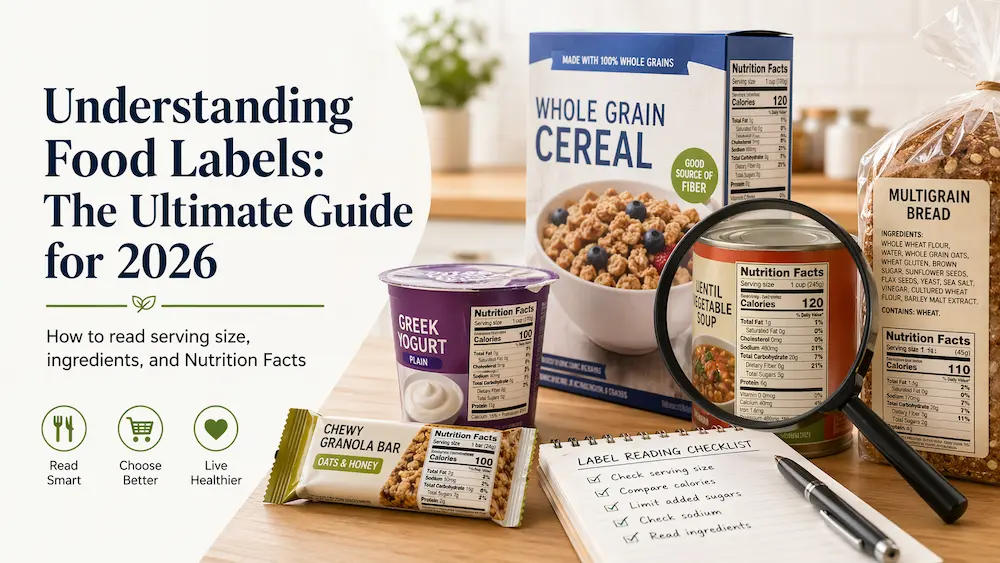
But then you turn the package over.
Suddenly you are looking at numbers, percentages, ingredient names you do not recognize, and a label that feels more confusing than helpful.
That is exactly why Understanding Food Labels matters in 2026 more than ever.
Food packaging has become smarter, louder, and more persuasive. At the same time, consumers are trying to make better decisions about sugar, sodium, protein, fiber, and overall diet quality. Learning how to read the Nutrition Facts label, interpret serving size, understand daily value percentages, and perform a quick ingredient list analysis can help you make better choices without overthinking every grocery trip.
This guide breaks the process down in a simple, practical way.
Why Understanding Food Labels Matters More in 2026
People are not just reading food labels to count calories anymore.
They are reading them to manage energy, reduce hidden sugar, limit sodium, choose better snacks, support weight goals, and improve long-term health. Whether you are comparing two breakfast cereals or deciding if a packaged food is actually nutritious, labels can help you see beyond the marketing.
That matters because the front of the package is designed to sell.
The back of the package is where the truth usually lives.
Reliable public resources like the FDA’s official guide to the Nutrition Facts label and Nutrition.gov from the USDA can help consumers understand how food labels fit into a balanced eating pattern.
A Basic List of Food Labels You Should Know
Before going deeper, it helps to understand the main parts of a packaged food label.
Here is a simple list of food labels and sections you will commonly see:
- Nutrition Facts label
- Serving size
- Calories per serving
- Macronutrients such as fat, carbohydrates, and protein
- Micronutrients such as calcium, iron, potassium, and vitamin D
- % Daily Value
- Ingredient list
- Allergen statement
- Front-of-pack claims such as “low sugar,” “high fiber,” or “gluten free”
- Certifications or seals such as organic or non-GMO
Not every part matters equally in every situation. But together, they give you a fuller picture of what you are really eating.
Understanding Food Labels Starts With Serving Size
If there is one place most people go wrong, it is serving size.
The label may look reasonable at first glance, but the numbers only make sense if you know how much food they apply to.
A bag of chips might look like it contains 150 calories. But if the serving size is only one-third of the bag, and you eat the whole thing, you have to triple everything:
- calories
- fat
- sodium
- sugar
- carbohydrates
That is why the first step in Understanding Food Labels is always to check the serving size before you judge anything else.
What to look for
Ask yourself:
- Is this serving realistic for how I actually eat?
- How many servings are in the package?
- Am I comparing two products using the same serving size?
This is especially important with:
- breakfast cereals
- ice cream
- crackers
- trail mix
- protein bars
- sweetened drinks
A product can appear healthier than it really is simply because the serving size is smaller than what most people consume.
How to Read the Nutrition Facts Label
Once you understand serving size, the Nutrition Facts label becomes much easier to use.
You do not need to analyze every line every time. You just need to know which parts deserve the most attention.
Start with calories, but do not stop there
Calories matter, but they do not tell the whole story.
Two foods can have the same calories and a very different impact on fullness, blood sugar, or overall nutrition. A 200-calorie snack with protein and fiber is not the same as a 200-calorie snack loaded with refined starch and added sugar.
Check these next
Focus on these key areas:
- Fiber
- Protein
- Added sugars
- Sodium
- Saturated fat
This quick review gives you a much better sense of quality than calories alone.
What Daily Value Percentages Actually Mean
One of the most overlooked parts of the label is the daily value percentages section.
This helps you understand whether a food is low or high in a specific nutrient.
A simple rule often used is:
- 5% Daily Value or less = low
- 20% Daily Value or more = high
This can help you quickly evaluate a product.
Examples
If a soup has:
- 25% Daily Value of sodium, it is high in sodium
- 4% Daily Value of fiber, it is low in fiber
- 22% Daily Value of calcium, it is a strong calcium source
This is one of the fastest ways to make better decisions at the store.
For consumer-friendly support, the FDA food labels guide explains how to use % Daily Value when comparing products.
Ingredient List Analysis: Where Hidden Truths Show Up
If the Nutrition Facts label tells you the numbers, the ingredient list tells you the story.
A strong ingredient list analysis can reveal whether a food is minimally processed, heavily sweetened, or full of additives that make it less nutritious than it seems.
Ingredients are listed in descending order by weight. That means the first few ingredients matter most.
What to ask when reading the ingredient list
- Is sugar near the top?
- Are whole foods listed first?
- Is the ingredient list short and recognizable?
- Are there multiple forms of sugar?
- Does the product sound healthier than its ingredients suggest?
Harvard’s nutrition guidance is especially useful here. The Harvard T.H. Chan School of Public Health offers trusted, practical information on food quality and ingredient awareness.
Food Label Ingredients List: What Deserves Extra Attention
The food label ingredients list matters because it helps you identify what marketing often hides.
A product may say:
- “made with fruit”
- “multigrain”
- “light”
- “natural”
- “energy boosting”
But the ingredient list may show:
- added sugars
- refined flour
- syrups
- starches
- artificial flavors
- sodium-heavy preservatives
That does not mean every packaged food is bad. It means labels should be read with context.
Watch for multiple forms of sugar
Manufacturers may use different names for sugar, such as:
- cane sugar
- brown rice syrup
- corn syrup
- dextrose
- fructose
- maltose
- honey
- agave
- fruit juice concentrate
When several of these appear in one product, the sugar load may be more significant than it first seems.
How to Spot Hidden Sugar Fast
If you want one practical grocery skill for 2026, learn to identify hidden sugar.
Sugar shows up in many foods people do not think of as sweet, including:
- salad dressings
- pasta sauces
- flavored yogurt
- granola
- protein bars
- breakfast cereals
- nut butters
- plant-based milks
- crackers
- bottled smoothies
A quick method
Use this three-step check:
- Look at added sugars on the Nutrition Facts label
- Scan the first five ingredients
- Ask whether the product is pretending to be healthier than it is
This is where Understanding Food Labels becomes a real-life habit instead of just a theory.
How to Recognize Hidden Sodium
Sugar gets a lot of attention, but sodium is another major issue in packaged foods.
People often associate sodium only with chips or fast food, but large amounts can also appear in:
- canned soups
- frozen meals
- sauces
- deli meats
- bread
- cheese products
- savory snacks
If a product has a high sodium % Daily Value, that matters, especially if you eat several processed foods in one day.
What to do
When comparing similar products, choose the one with:
- lower sodium
- higher fiber
- fewer added sugars
- more recognizable ingredients
You do not need perfection.
You just need better comparisons.
FDA Food Labels: What They Are Designed to Do
When people search for FDA food labels, they usually want to know how the official label should be used.
The main job of the FDA label system is to help consumers understand what is in a packaged food and compare products more accurately.
The FDA’s official labeling guide explains core features such as:
- serving size
- calories
- nutrients to limit
- nutrients to get more of
- % Daily Value
This makes the label one of the most practical public-health tools available to shoppers.
FAO Food Labeling: Why Global Standards Matter
When people search for FAO food labeling, they are often looking for broader international guidance on food standards, transparency, and labeling systems.
The Food and Agriculture Organization of the United Nations plays an important role in food policy, food systems, and consumer information. FAO-related guidance is especially relevant when discussing international food labeling frameworks, nutrition communication, and how countries support safer and clearer food choices.
For blog readers, the practical takeaway is simple: clear labeling is not just a local issue. It is part of a wider global effort to help people make safer and more informed food decisions.
Understanding Food Labels for Better Everyday Choices
You do not need to read every label like a scientist.
You just need a repeatable process.
A simple 5-step method
- Check the serving size
- Look at calories in context
- Review added sugars and sodium
- Check fiber and protein
- Scan the ingredient list
That process takes less than a minute once you get used to it.
What matters most
If you are in a hurry, focus on these priorities:
- lower added sugar
- reasonable sodium
- more fiber
- decent protein
- simpler ingredient list
That alone can improve your grocery decisions dramatically.
Common Label Claims That Can Mislead You
Some front-of-pack claims sound impressive but tell only part of the story.
Be cautious with:
- “natural”
- “made with whole grains”
- “low fat”
- “lightly sweetened”
- “high protein”
- “multigrain”
- “no cholesterol”
These claims are not always false.
They are just incomplete.
A product can be “high protein” and still contain lots of added sugar.
It can be “low fat” and still be heavily processed.
Always verify the claim with the actual label.
FAQ
What is the Nutrition Facts label?
The Nutrition Facts label is the standardized panel on packaged foods that shows serving size, calories, nutrients, and % Daily Value to help consumers compare products and make informed choices.
Why is serving size so important?
Serving size matters because all the numbers on the label are based on that amount. If you eat double the serving, you consume double the calories, sodium, sugar, and other nutrients.
What do daily value percentages mean?
Daily value percentages show whether a food is low or high in a nutrient. Around 5% is considered low, while 20% or more is considered high.
What is ingredient list analysis?
Ingredient list analysis means reviewing the ingredients to see what the product is really made of, with special attention to added sugars, refined ingredients, and the order in which ingredients appear.
How can I identify hidden sugar on food labels?
Look at the added sugars line on the Nutrition Facts label and scan the ingredient list for names like syrup, cane sugar, dextrose, honey, or fruit juice concentrate.
What are FDA food labels?
FDA food labels refer to the official food labeling format and guidance used in the United States to help consumers understand packaged food nutrition information.
What is FAO food labeling?
FAO food labeling refers more broadly to international food labeling guidance and policy work related to consumer information, nutrition, and food standards.
Final Takeaway
If you want to eat better in 2026, start by reading labels better.
That does not mean obsessing over every product. It means learning how to spot the few details that matter most: serving size, daily value percentages, added sugars, sodium, and ingredient quality.
Once you know how to do that, the label stops being confusing and starts becoming useful.
And that is the real power of Understanding Food Labels: it helps you make smarter choices with more confidence, one package at a time.