
Late-night soda. “Sugar-free” coffee. A protein bar that tastes like dessert. Most people are not choosing between perfect health and junk food. They are choosing between real sugar and something marketed as the “better” option.
That is where things get confusing.
Artificial sweeteners are often sold as the smart swap. Less sugar, fewer calories, smaller blood sugar spikes. Sounds simple. But here’s the twist: the science is more nuanced than the marketing. Some sweeteners may help reduce sugar intake in certain situations. Others may keep cravings alive, alter eating behavior, or raise new questions about the gut microbiome and long-term weight management.
This article breaks down the real scientific showdown between sugar and artificial sweeteners and answers these questions:
- Are artificial sweeteners better than real sugar?
- What are artificial sweeteners?
- Can you eat sugar if you have artificial sweeteners?
- How many artificial sweeteners are there?
I cannot verify live updates right now because web access is unavailable in this chat, but I’ve used well-known, authoritative medical and scientific sources and linked them directly below.
What Are Artificial Sweeteners?
Artificial sweeteners are high-intensity sweeteners that provide a sweet taste with little or no calories. They are used in diet sodas, sugar-free desserts, chewing gum, flavored yogurt, protein powders, tabletop packets, and many “light” or “diabetic-friendly” products.
Common examples include:
- Aspartame
- Sucralose
- Saccharin
- Acesulfame potassium (Ace-K)
- Neotame
- Advantame
Some people also group non-sugar sweeteners like stevia and monk fruit into the same everyday conversation, although technically those are not all artificial. The World Health Organization uses the broader term non-sugar sweeteners in some guidance.
How Many Artificial Sweeteners Are There?
If we are speaking strictly about the major widely recognized artificial sweeteners used in foods and drinks, the commonly cited group includes six main sweeteners:
- Aspartame
- Sucralose
- Saccharin
- Acesulfame potassium
- Neotame
- Advantame
The exact count can vary depending on country regulations and whether someone includes sugar alcohols or plant-derived sweeteners in the same category. For a practical consumer answer, six major artificial sweeteners is a fair number.
For background, Mayo Clinic gives a clear overview of sweeteners and sugar substitutes here.
Are Artificial Sweeteners Better Than Real Sugar?
Sometimes, yes. Automatically, no.
That is the most honest answer.
Artificial sweeteners may be better than sugar in some specific contexts:
- They usually contain few or no calories
- They often have a lower immediate effect on blood glucose
- They may help some people reduce added sugar intake
- They can be useful for people trying to cut sugary drinks
But “better” depends on what outcome you care about.
If your goal is:
Lower blood sugar spikes
Artificial sweeteners often look better than sugar in the short term, because they usually do not raise blood glucose in the same way table sugar does.
Lower calorie intake
They can help if they replace sugar without causing compensation later, such as eating more elsewhere.
Better long-term weight control
This is where things get messy. Some randomized trials suggest substitution can help, especially when sugary drinks are replaced. But observational studies sometimes show people who use more diet products still struggle with weight. That does not prove sweeteners cause weight gain, but it suggests the real-life picture is more complicated.
Harvard Health discusses this tension in a consumer-friendly way here.
Sugar vs. Artificial Sweeteners at a Glance
| Factor | Sugar | Artificial Sweeteners |
|---|---|---|
| Calories | Usually high | Usually very low or zero |
| Glycemic index | Varies, but often higher | Usually very low or none |
| Blood glucose impact | Typically raises blood glucose | Often minimal immediate rise |
| Insulin impact | Can stimulate insulin response through glucose rise | Usually smaller, but responses may vary |
| Common sources | Soda, desserts, pastries, sauces, candy | Diet soda, sugar-free yogurt, gum, protein products |
| Satiety | Often poor in liquid form | May not improve fullness much |
| Cravings effect | Can reinforce sweetness preference | May keep sweet taste habits alive |
| Best use case | Occasional intake, ideally limited | Transitional sugar reduction tool, not a magic solution |
The Metabolic Battle: Insulin, Blood Glucose, and Fat Storage
This is the section most people care about most.
Sugar and blood glucose
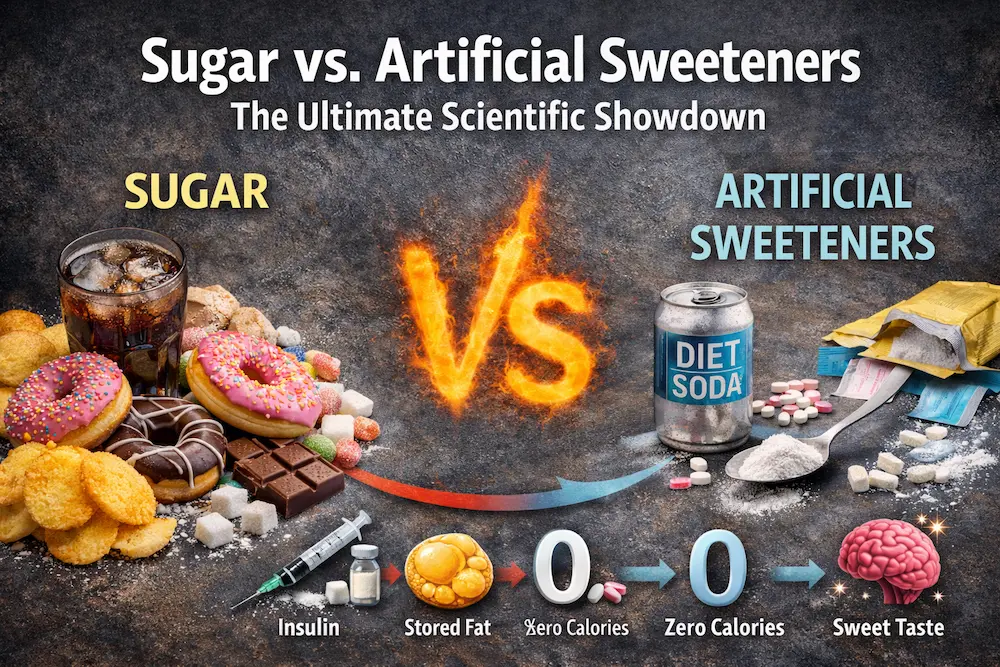
Regular sugar, especially in drinks and refined foods, raises blood glucose quickly. That triggers insulin release. Over time, frequent excess intake can contribute to:
- Higher calorie intake
- Poorer insulin sensitivity
- Increased fat storage
- Worse metabolic health
The science linking excess added sugar, especially sugary beverages, to poorer metabolic outcomes is strong enough that major health groups recommend limiting it. The WHO guideline on non-sugar sweeteners and broader sugar-related guidance provide useful context here.
Artificial sweeteners and insulin sensitivity
Artificial sweeteners usually do not behave exactly like sugar in terms of immediate glucose load. That is their biggest advantage. They can reduce the glycemic burden of foods and drinks.
But some studies have raised questions about whether certain sweeteners might still influence metabolic signaling, appetite, or insulin sensitivity indirectly in some people. The results are not fully consistent across populations or sweetener types.
For deeper reading, PubMed has a broad body of studies on artificial sweeteners and insulin sensitivity here.
Glycemic index: where it matters
The glycemic index measures how quickly a carbohydrate-containing food raises blood sugar. Artificial sweeteners generally have little or no glycemic effect because they contribute little glucose.
That means for someone comparing a regular soda versus a diet soda, the diet version usually has the lower glycemic impact. But lower glycemic index does not automatically mean healthier overall if the person uses it to keep an ultra-sweet diet pattern going.
The Brain, Dopamine, and Cravings
This is where the story stops being just about calories.
Sugar activates reward pathways in the brain. Sweet taste, energy delivery, and rapid reinforcement can all feed the craving cycle. That is one reason sugar can feel emotionally “sticky.”
Real sugar and dopamine
- Sweet taste
- Actual caloric energy
That combination can strengthen the reward loop. It is not just sweet. It is sweet plus fuel.
Artificial sweeteners and the “sweetness trickery” problem
Artificial sweeteners give intense sweetness without the same calorie delivery. Some scientists have wondered whether this mismatch may affect reward learning, appetite regulation, or cravings in certain people.
That does not mean sweeteners are dangerous by default. It means they may not always solve the deeper issue: a brain and palate trained to expect intense sweetness all day.
Harvard Health has covered the behavioral side of artificial sweetener use and appetite here.
Most people fail here because they focus only on the ingredient and ignore the pattern. A person who swaps regular soda for diet soda but still eats a highly processed, ultra-sweet diet may not see the benefits they expected.
Gut Microbiome: Can Artificial Sweeteners Affect Gut Bacteria?
This is one of the most talked-about areas in recent years.
Some research suggests certain non-sugar sweeteners may alter the gut microbiome in ways that could affect glucose metabolism in some people. But the evidence is still evolving, and not all sweeteners appear to behave the same way.
A widely discussed line of research has suggested that microbiome changes could be part of the reason some people respond differently to sweeteners. That said, this field is still developing, and headlines often run ahead of the evidence.
For scientific background, PubMed has many papers on sweeteners and gut microbiota here.
You can also explore major journal coverage through The Lancet and linked related literature there.
What we can say cautiously
- Some artificial sweeteners may alter gut bacteria in certain contexts
- Effects may differ by sweetener, dose, and person
- The microbiome findings are interesting, but they do not yet justify blanket fear
That is important. This is a field for careful interpretation, not social-media panic.
Weight Loss Paradox: Why Sweeteners Do Not Always Deliver
Here’s where many people feel frustrated.
A person switches to diet drinks and sugar-free snacks, but the scale barely moves. Why?
Possible reasons
- They compensate by eating more elsewhere
- Sweeteners maintain a strong preference for hyper-sweet foods
- They assume “sugar-free” means unlimited
- They focus on substitution, not total dietary pattern
- Weight struggles are also shaped by sleep, stress, activity, medications, and overall calorie intake
The WHO released guidance in 2023 suggesting that non-sugar sweeteners should not be relied on as a long-term weight control strategy, based on evidence showing no clear long-term benefit for reducing body fat in many people and possible associations with other risks. That guidance is here.
This does not mean one diet soda causes harm. It means sweeteners are tools, not miracles.
Sucralose vs Aspartame: Which Is Better?
This is one of the most searched questions for a reason.
Sucralose
- Very sweet, commonly used in baked or packaged foods
- Often found in “zero sugar” products
- Heat-stable, which makes it popular in processed items
Aspartame
- Common in diet sodas and tabletop packets
- Not as heat-stable as sucralose
- Has been studied extensively for safety at approved intake levels
There is no simple universal winner in the sucralose vs aspartame debate. Differences may matter depending on:
- Your digestion
- Your intake level
- Whether you mainly consume beverages or processed foods
- Your individual tolerance and preferences
For reliable overviews, see:
Sugar-Free Myths That Confuse Almost Everyone
Myth 1: Sugar-free means healthy
Not necessarily. A sugar-free cookie can still be highly processed and calorie-dense.
Myth 2: Artificial sweeteners are always worse than sugar
Also not true. Replacing several daily sugary drinks with unsweetened or lower-calorie options can be a meaningful step.
Myth 3: If something has no sugar, it cannot affect appetite
False. Sweet taste, eating behavior, habits, and reward pathways still matter.
Myth 4: You must pick one forever
No. Many people do best by reducing both added sugar and dependence on intensely sweet substitutes over time.
Can You Eat Sugar If You Have Artificial Sweeteners?
Yes, you can, but the better question is whether combining both helps your overall health goals.
Many people use artificial sweeteners and still consume significant sugar. In practice, that often means they are not replacing sugar, just adding more sweet exposure from multiple sources.
If you are using artificial sweeteners, it makes sense to ask:
- Are they helping me reduce total added sugar?
- Are they keeping cravings strong?
- Am I using them as a bridge to healthier habits, or as permission to eat more sweets?
For most people, the goal should not be “pick Team Sugar” or “pick Team Sweeteners.” The goal is to reduce total reliance on intense sweetness and build a more stable eating pattern.
So Which Is Better for Health?
Here is the balanced answer:
Artificial sweeteners may be better than sugar when:
- They replace high-sugar drinks
- They help reduce immediate blood sugar load
- They lower total calorie intake without rebound overeating
- They are used as a transition step, not a forever crutch
Real sugar may be less problematic when:
- It is used occasionally and mindfully
- It appears in a generally balanced diet
- It is not consumed heavily in liquid form
- It does not dominate your daily food choices
The best long-term strategy
For many people, the healthiest pattern is:
- Less added sugar
- Less dependence on ultra-sweet processed foods
- More water, whole foods, protein, fiber, and minimally processed meals
- Strategic, limited use of sweeteners if helpful
That approach is usually more realistic than extreme rules.
Practical Takeaways
- Artificial sweeteners are not automatically healthier, but they can be useful in specific cases
- Sugar has clearer metabolic downsides when consumed in excess, especially in beverages
- Sweeteners may help lower sugar intake, but they do not fix cravings, habits, or diet quality by themselves
- The microbiome and long-term metabolic effects are still being studied
- The smartest move is often reducing both excess sugar and chronic dependence on very sweet foods
Talk to Your Doctor
The information provided is for educational purposes. Every body is different; you must consult your healthcare provider or a licensed physician before changing your intake of sweeteners or sugar, especially if you have underlying conditions like diabetes or metabolic syndrome.
This matters even more if you have:
- Diabetes or prediabetes
- Insulin resistance
- Metabolic syndrome
- Digestive issues
- A history of binge eating or disordered eating
- Concerns about weight management
A doctor or registered dietitian can help you decide whether reducing sugar, using artificial sweeteners, or changing both makes the most sense for your body and your goals.
Final Thoughts
The real showdown is not just sugar vs. artificial sweeteners. It is short-term convenience vs. long-term metabolic habits.
Sugar clearly carries stronger risks when intake is high and frequent. Artificial sweeteners can be helpful tools, especially for reducing sugar-sweetened beverages. But they are not a free pass, and they do not always deliver the long-term benefits people expect.
The smartest choice is rarely the most extreme one. It is the one that helps you eat in a way that is less reactive, less processed, and easier for your body to handle over time.
Which one do you rely on more right now: real sugar or sugar-free products?
Sources Mentioned
- World Health Organization (WHO): Use of non-sugar sweeteners
- Harvard Health Publishing: Artificial sweeteners: sugar-free, but at what cost?
- Mayo Clinic: Artificial sweeteners and other sugar substitutes
- PubMed (NCBI): Artificial sweeteners and insulin sensitivity
- PubMed (NCBI): Artificial sweeteners and gut microbiome
- PubMed (NCBI): Sucralose vs aspartame
- The Lancet: Journal homepage for related reviews and studies